
Why PMDC is screening medical and dental students for mental health
Around 22,500 students, alongside faculty and staff, are to undergo yearly mental-health screening as Pakistan’s medical education system confronts psychological distress, recent student deaths and new national data showing a far wider mental-health burden.
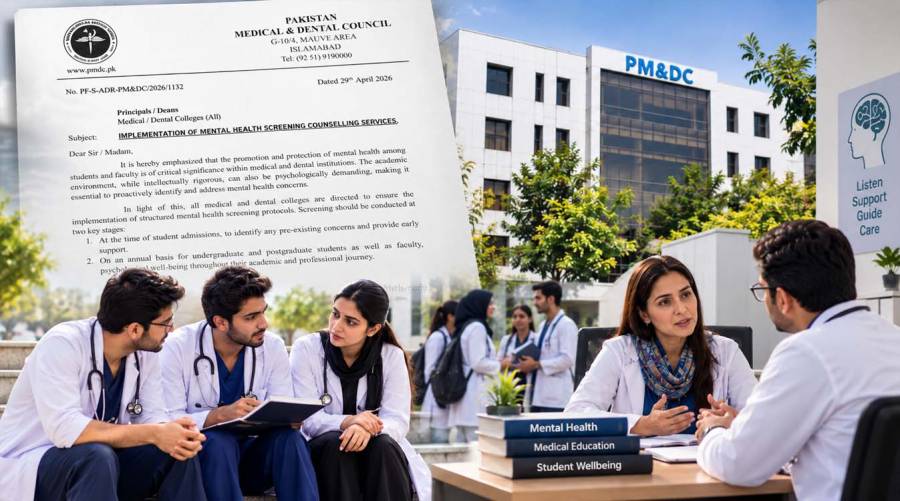
ISLAMABAD: The Pakistan Medical and Dental Council has ordered annual mental-health screening for around 22,500 medical and dental students, together with faculty and staff, moving psychological wellbeing from an institutional welfare issue towards a recurring regulatory requirement across Pakistan’s medical education system.
Professor Dr. Rizwan Taj, President of the Pakistan Medical and Dental Council (PMDC), said the screenings are intended to identify psychological distress, emotional difficulties and suicide risk early enough for people to be connected with professional support before their condition deteriorates. He announced the measure during the Pakistan Global Mental Health Summit 2026 in Islamabad.
The announcement is significant not simply because of the number of students involved, but because it formalises a direction PMDC had already begun developing earlier this year — after a series of deaths and reported episodes of severe distress among students raised difficult questions about how medical colleges identify, respond to and prevent psychological crises.
The October announcement began with an April order
The latest initiative is not an isolated decision.
On April 29, 2026, PMDC formally wrote to principals and deans of all medical and dental colleges through notification No. PF-5-ADR-PM&DC/2026/1132, directing institutions to implement mental-health screening and counselling services.
That directive required screening at two stages: first, at the time of admission to identify pre-existing concerns and provide early support; and then annually for undergraduate and postgraduate students as well as faculty.
PMDC recommended validated assessment tools including the General Health Questionnaire (GHQ), Patient Health Questionnaire-9 (PHQ-9), Hospital Anxiety and Depression Scale (HADS) and Beck Suicide Inventory. Anyone identified as requiring further evaluation or support was to be referred promptly to the Psychiatry Department for assessment, management and follow-up.
The Council also made it mandatory for institutions to maintain a fully functional Psychiatry Department with a counselling section, adequately staffed and equipped to provide confidential psychological support, guidance and intervention.
The wording of the April directive is important. PMDC explicitly referred to growing public and legislative concern over mental illness and student suicides, instructed institutions to take responsibility for preventing and addressing psychological harm, and told colleges to treat implementation as urgent.
Why PMDC is moving now
That concern did not emerge in a vacuum.
In February 2026, PMDC took notice of the death of a 22-year-old final-year MBBS student at Fatima Jinnah Medical University (FJMU), Lahore, after a hostel fall that was investigated as a possible suicide. PMDC sought a factual report from the university and, citing weaknesses in student-support systems, advised medical and dental colleges to appoint qualified counsellors and psychologists and establish confidential support mechanisms for students experiencing stress, anxiety, depression or burnout. Dawn
The circumstances of the FJMU student's death were subject to investigation, and institutional accounts differed at the time over whether the fall was accidental or intentional. That uncertainty is important and should not be erased in retrospect.
Two months later, another case brought student wellbeing, institutional conduct and harassment safeguards into even sharper focus.
Fehmida Leghari, a third-year medical student in Mirpurkhas, died in April amid allegations from her family that she had been subjected to sustained harassment. Police registered a case involving alleged harassment and abetment to suicide, while inquiries were initiated and one lecturer was arrested. PMDC sought records from the college and an inquiry report from the Sindh government, while reiterating that anti-harassment committees were mandatory in medical and dental colleges.
Those allegations were matters for investigation and should not be treated as established causation. But together with the FJMU case and other student-welfare concerns, they illustrate why PMDC’s regulatory approach is increasingly moving beyond curriculum and examinations toward the psychological environment in which medical and dental students are trained.
Mental health is now entering the curriculum itself
PMDC’s latest approach goes beyond screening.
Professor Dr. Rizwan Taj told the summit that mental health has been made an independent and compulsory subject in undergraduate medical and dental education.
According to his announcement, teaching time devoted to mental health has increased from 50 hours to 175 hours, with plans to raise it further to 200 hours. Medical and dental colleges have also been directed to establish primary mental-health care centres capable of providing support and referral services. The News
That represents an important shift in medical education.
The policy is no longer focused solely on protecting students experiencing distress. It also seeks to ensure that future doctors and dentists are better prepared to recognise mental-health conditions in the patients they will eventually treat.
Pakistan launches National Mental Health Policy 2026-2035
PMDC’s announcement came against a much broader national policy shift.
At the same summit, Federal Minister for Health Syed Mustafa Kamal launched the National Mental Health Policy 2026-2035, designed to bring mental-health services closer to communities and integrate care more strongly into primary healthcare and other everyday settings.
The summit was convened by the Ministry of National Health Services, Regulations and Coordination, with partners including the World Health Organization, UNICEF and the Global Institute of Human Development at Shifa Tameer-e-Millat University. Government described the policy as an effort to reach more than 32 million Pakistanis estimated to require mental-health support.
The timing matters because new national evidence suggests the underlying burden is substantially larger than older estimates had indicated.
Nearly one in three adults: the evidence behind the urgency
Pakistan’s first nationally representative psychiatric morbidity survey was published in BMJ Public Health on September 25, 2026.
Researchers interviewed 17,773 adults aged 18 and above across Punjab, Sindh, Khyber Pakhtunkhwa and Balochistan between 2019 and 2022 using a structured psychiatric assessment.
The study found a 32.3% current prevalence of diagnosable mental and behavioural disorders and a lifetime prevalence of about 37.9%. Around 6.2% of participants reported some form of suicidality during the preceding month, while about 1.1% reported a lifetime suicide attempt. PubMed
Professor Dr. Mohammad Iqbal Afridi, Professor Emeritus of Psychiatry and a co-author of the study, said the findings provide a stronger national evidence base for planning mental-health services, workforce development and community-based care.
One distinction is essential, however: these figures describe Pakistan’s adult population as a whole, not medical and dental students specifically. They should therefore provide national context, not be interpreted as the prevalence of psychiatric disorders among medical students.
From reaction to prevention
For years, mental-health discussions inside professional education often began after a crisis.
PMDC’s emerging policy attempts to reverse that sequence: screen earlier, create counselling capacity before it is needed, teach mental health formally, establish referral systems and make institutions responsible for responding to psychological distress.
Academic pressure, institutional culture, harassment safeguards, accessibility of counselling, confidentiality and trust can all influence whether a student seeks help before a crisis develops.
PMDC has now placed the responsibility squarely on medical and dental institutions.
The real measure of the reform will therefore not be how many screening forms are completed each year, but whether students and staff who are identified as struggling can actually reach competent, confidential and timely care.
Stay connected with Medical News Pakistan
CLICK HERE TO FOLLOW the official Medical News Pakistan WhatsApp Channel for verified global medical breakthroughs, FDA approvals, healthcare innovations, clinical research updates, public-health developments and important medical news affecting Pakistan and the world.

Advertisement
E-PAPER
Trending
Popular
Global life expectancy rebounds, but healthy years lag behind
-
Scientists discover new human blood ...
04:49 PM, 2 Oct, 2026 -
Obesity linked to 229 diseases, may ...
05:28 PM, 21 Sep, 2026 -
Pakistan’s Dr. Misha Tanveer takes ...
04:03 PM, 16 Sep, 2026 -
Calorie deficit for weight loss: How to ...
06:00 PM, 24 Aug, 2026
Follow us on Facebook
Follow us on Twitter
Copyright ©2026 Medical News. All Rights Reserved.