PMDC drops MDCAT rule for students seeking medical education abroad
Nearly two years after making a 50% MDCAT score a gateway for Pakistani students pursuing medical and dental degrees overseas, the regulator has withdrawn the requirement — following Senate scrutiny over its legal basis, purpose and impact. But the latest notice leaves important questions unanswered for students already caught under the previous policy.
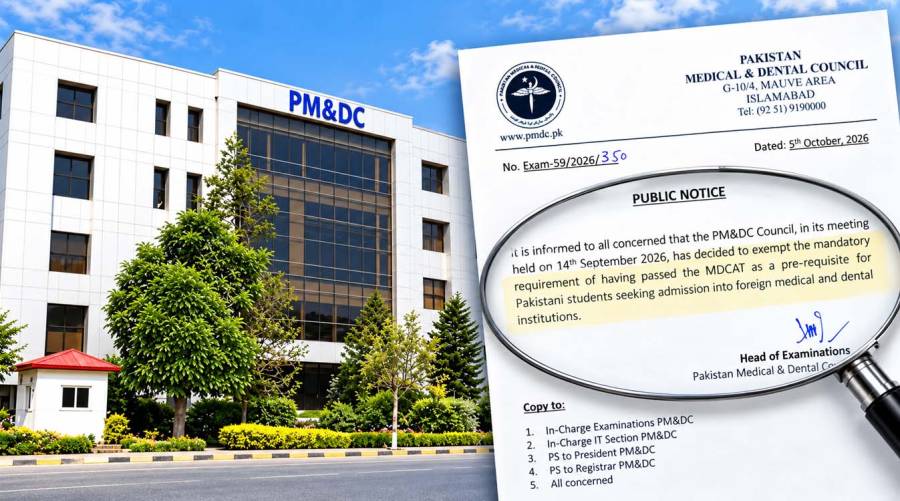
ISLAMABAD: The Pakistan Medical and Dental Council has removed the requirement for Pakistani students to pass the Medical and Dental College Admission Test before seeking admission to undergraduate medical and dental institutions abroad, reversing a regulatory condition that had shaped overseas medical admissions since the 2024-25 academic session.
In a public notice dated October 5, 2026, the Pakistan Medical and Dental Council (PMDC) said its Council, at a meeting held on September 14, 2026, decided to exempt Pakistani students seeking admission to foreign medical and dental institutions from the mandatory prerequisite of having passed MDCAT.
The apparently brief notice brings a significant policy shift.
For almost two academic cycles, students who completed their intermediate education in Pakistan had repeatedly been told that they needed at least 50% marks in MDCAT before proceeding to foreign undergraduate medical or dental education if they wanted to remain within PMDC's registration and licensing pathway.
As recently as May 2026, the Council was again publicly telling students that at least 50% in MDCAT — or an equivalent examination from abroad under its policy — was part of the criteria for admission to foreign undergraduate medical and dental institutions. Pakistan Medical and Dental Council
Now, that gate has been removed.
The PMDC website listed the new “Public Notice Regarding Exemption of MDCAT for seeking Admission in Foreign Institutions” on October 5, confirming the latest change in policy.
How MDCAT became a condition for studying medicine abroad
The roots of the policy go back to 2024.
PMDC's public-announcement archive shows a policy for Pakistani students seeking admission to undergraduate foreign medical and dental institutions published in July 2024. The framework was expressly intended to apply from the 2024-25 academic session.
An August 22, 2024 joint statement from PMDC and the Ministry of National Health Services, Regulations and Coordination made the requirement explicit: Pakistani students pursuing medicine or dentistry overseas were required, among other conditions, to obtain at least 50% marks in MDCAT conducted in Pakistan. The policy also required academic eligibility, PMDC student registration, an appropriately recognised foreign institution, defined study hours and attendance, and eventual qualification of the National Registration Examination for full registration in Pakistan.
The stated rationale was quality control.
PMDC and the ministry said the framework was intended to prevent students from entering foreign institutions with inadequate academic standards and to improve the eventual integration of foreign-trained graduates into Pakistan's healthcare system.
But the MDCAT condition was not a one-off announcement.
A PMDC public notice dated November 27, 2024 again stated that students seeking foreign medical or dental admission from the 2024-25 session had to obtain 50% in MDCAT and register with PMDC. It also linked compliance with the requirements to subsequent provisional registration and eligibility for the National Registration Examination.
The requirement was reiterated again in student alerts during 2025. One PMDC alert stated that students enrolling abroad from the 2024-25 session had to obtain 50% in MDCAT, while also warning that foreign graduates who were not registered as foreign students on the PMDC portal would not be permitted to appear in the NRE.
The effect was therefore much wider than simply sitting another examination before leaving Pakistan.
A foreign university might have been willing to admit a Pakistani student without MDCAT, but PMDC's policy effectively made the test part of that student's future pathway back into the Pakistani regulatory system.
Why the requirement became controversial
The MDCAT requirement came under particularly sharp scrutiny in 2026.
On June 5, a subcommittee of the Senate Standing Committee on National Health Services, Regulations and Coordination, convened by Senator Anusha Rahman Ahmed Khan, questioned the legal basis for compelling students going overseas to sit MDCAT.
PMDC officials told the committee that the policy was intended to discourage students from enrolling in substandard foreign medical colleges.
But committee members questioned the connection between the two issues: how, they asked, would passing MDCAT determine whether a university abroad was academically sound?
The Senate body directed PMDC and the Ministry of National Health Services, Regulations and Coordination to provide the legal provisions authorising the regulator to impose MDCAT on students seeking medical education overseas. It suggested that the regulator could instead identify foreign institutions that failed to meet standards and warn students against joining them.
That legal question was significant because Section 17 of the Pakistan Medical and Dental Council Act, 2022 describes MDCAT as the admission examination for undergraduate medical and dental colleges and universities and specifically states that a student cannot be awarded a medical or dental degree “in Pakistan” without having passed MDCAT before admission to a medical or dental college “in Pakistan.”
The law also gives PMDC broader authority to assess international undergraduate medical programmes and institutions for the purpose of registering their graduates in Pakistan, meaning the regulatory issue was more complex than simply reading Section 17 in isolation.
The Senate committee did not, in the material reviewed, make a judicial finding that the overseas MDCAT requirement was unlawful. Instead, it questioned the statutory basis and asked PM&DC to justify it.
That distinction matters.
Students faced a test that did not decide their foreign admission
One of the central criticisms was that MDCAT had originally been designed as an admission test for Pakistan's medical and dental colleges.
Students planning to study abroad could therefore find themselves required to clear a Pakistani entrance examination even where their chosen foreign university did not require it.
The policy's consequences were potentially substantial because compliance was tied to PMDC registration and, in previous notices, eventual eligibility for the NRE.
In July 2026, the Senate subcommittee again questioned why registration with PMDC could not itself be used to identify students entering unsuitable overseas institutions rather than making MDCAT the screening mechanism.
The committee cited figures showing that more than 168,000 students appeared in MDCAT in 2024, with more than 113,000 qualifying, against about 22,300 medical seats, illustrating the scale of the gap between students clearing the examination and places available within Pakistan.
For many of those unable to secure a domestic seat, overseas medical education represented an alternative pathway.
The additional MDCAT restriction meant that a test designed around Pakistani admissions also became a regulatory hurdle for that alternative.
PMDC was still enforcing the requirement months ago
What makes the October decision particularly notable is how recently PMDC had reaffirmed the opposite position.
Its May 14, 2026 public notice said students seeking admission to foreign undergraduate medical or dental institutions had to obtain at least 50% marks in MDCAT conducted in Pakistan or an equivalent from abroad, have at least 60% in FSc Pre-Medical or equivalent, and complete mandatory PMDC registration.
Separate policy guidelines available on the PMDC website also listed a 50% MDCAT score for students who completed intermediate education in Pakistan, alongside requirements involving the foreign institution, student registration, a five-year programme with at least 6,200 study hours and 80% attendance, language preparation in non-English-speaking countries, a multiple-entry visa and eventual passage of the NRE.
Less than five months later, the Council decided that MDCAT would no longer be a mandatory prerequisite.
That amounts to a substantive policy reversal, regardless of whether the Council formally describes it as an exemption rather than a withdrawal.
What the October 5 notice changes — and what it does not
The most immediate consequence is clear: Pakistani students seeking admission to foreign medical and dental institutions no longer need to have passed MDCAT as a prerequisite under the new Council decision.
But the notice should not be interpreted as removing PMDC oversight of foreign medical education altogether.
The October notification addresses only the MDCAT prerequisite.
It does not say that requirements relating to student registration, the acceptability of a foreign institution, programme standards or subsequent licensing in Pakistan have been abolished.
Most importantly, foreign-trained medical and dental graduates seeking full registration in Pakistan remain subject to the National Registration Examination, under the PMDC Act. Section 18 provides that graduates with qualifying foreign medical or dental degrees must pass the NRE before being granted full registration to practise in Pakistan.
In other words, removing MDCAT before departure is not the same as removing the professional assessment that applies when a foreign graduate seeks Pakistani licensure.
That distinction will be crucial for students and parents interpreting the new notice.
The biggest questions are still unanswered
The new notification resolves one long-running issue but creates several practical questions that PMDC will now need to clarify.
It does not specify an academic session from which the exemption takes effect.
It does not explain whether the decision has any retrospective application for students who enrolled abroad after 2024-25 without passing MDCAT, or for candidates who were previously told they could not remain within the PMDC registration pathway because they had failed to meet the requirement.
Nor does the notice explain how students whose admission decisions were delayed or altered because of the earlier rule will be treated.
For families making decisions involving several years of education, significant financial commitments and eventual professional licensing, certainty in regulation matters almost as much as the regulation itself.
PMDC introduced the foreign-study MDCAT threshold from the 2024-25 session as part of a wider attempt to protect educational standards. It repeatedly reinforced the condition through 2025 and again in 2026.
The Senate then questioned both its legal foundation and its effectiveness as a tool for controlling the quality of overseas medical education.
On September 14, the Council changed course.
And on October 5, Pakistani students were formally told that MDCAT was no longer the mandatory gateway to medical or dental education abroad.
What remains now is for PMDC to spell out, in one definitive policy, precisely how the new exemption applies — particularly to the students who spent the past two years planning their medical education under the rule that has just been withdrawn.
Stay connected with Medical News Pakistan
CLICK HERE TO FOLLOW the official Medical News Pakistan WhatsApp Channel for verified global medical breakthroughs, FDA approvals, healthcare innovations, clinical research updates, public-health developments and important medical news affecting Pakistan and the world.

Advertisement
E-PAPER
Trending
Popular
Scientists discover new human blood group after solving 50-year ...
-
Dow launches ‘Bug & Drug’ app to ...
03:48 PM, 30 Sep, 2026 -
Obesity linked to 229 diseases, may ...
05:28 PM, 21 Sep, 2026 -
Pakistan’s Dr. Misha Tanveer takes ...
04:03 PM, 16 Sep, 2026 -
Calorie deficit for weight loss: How to ...
06:00 PM, 24 Aug, 2026
Follow us on Facebook
Follow us on Twitter
Copyright ©2026 Medical News. All Rights Reserved.