
PMA announces nationwide strike as YDA Sindh backs Sept 30 protest over FBR measures
Medical establishments have been asked to close on Sept 30 as PMA protests FBR’s POS requirements and alleged tax-authority harassment, while YDA Sindh and allied health-worker bodies announce solidarity
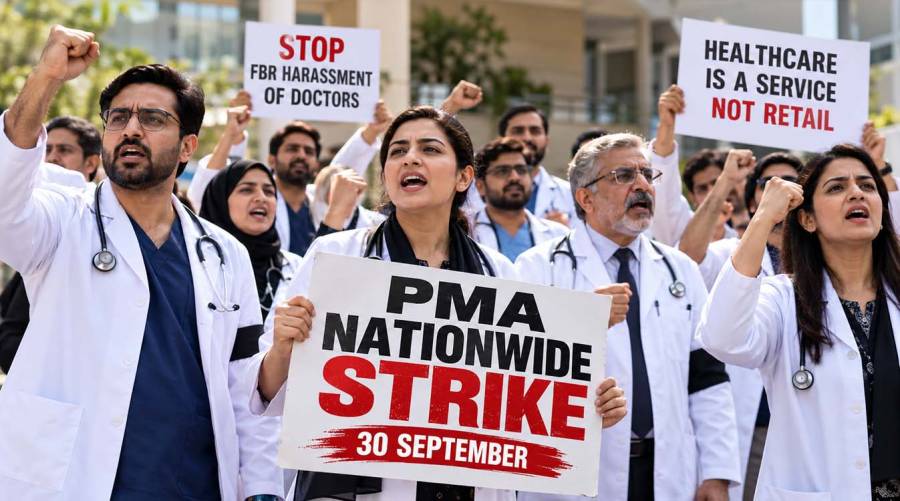
KARACHI: The Pakistan Medical Association (PMA) has announced a nationwide strike and closure of medical establishments on September 30, escalating its protest against what it describes as Federal Board of Revenue (FBR) tax measures, raids, fines and harassment targeting private healthcare providers.
The move has now received support from the Young Doctors Association Sindh (YDA Sindh) and organisations representing health workers in the province, adding another layer of professional backing to the planned protest.
PMA said all medical establishments across the country would remain closed on September 30 as part of the protest, with its provincial and local chapters coordinating implementation alongside allied medical organisations. The association has also said provincial and local PMA leaders will hold simultaneous news conferences to explain their concerns to the public and media.
PMA targets FBR’s POS requirement for healthcare providers
At the centre of the dispute is the PMA's objection to what it describes as the reclassification of healthcare services as retail sales and the requirement for private hospitals and other healthcare providers to install Point of Sale (POS) systems.
PMA Secretary General Dr Abdul Ghafoor Shoro said the medical community rejects the treatment of healthcare providers as retail businesses, arguing that hospitals and clinics provide medical treatment rather than sell commercial commodities.
The association maintains that private hospitals provide more than 70 per cent of Pakistan's healthcare services and already meet their tax obligations through regular income-tax payments.
PMA has also alleged that private healthcare providers are facing heavy fines, raids on hospital premises and persistent pressure from tax authorities, which it says is making it increasingly difficult to operate medical institutions.
These are the PMA's stated objections; the FBR's publicly available material separately documents its broader POS integration framework and the existing POS system for integrated retailers.
YDA Sindh joins PMA in opposing the measures
The dispute has also drawn an expression of solidarity from the Young Doctors Association Sindh.
In a statement, YDA Sindh said it, along with organisations representing health workers, stands shoulder to shoulder with the PMA against policies by the federal and provincial governments and the FBR that it says affect doctors and healthcare professionals.
The organisation has called on doctors across Pakistan to participate in peaceful protests while wearing black armbands on September 30, describing the action as an effort to raise their voice for doctors' rights, dignity and professional standing.
YDA Sindh said doctors belong to a profession dedicated to patient care and called for unity among doctors and health workers against policies and measures it considers harmful to the healthcare sector.
The statement was issued by Dr Mehboob Ali Noonari, Chairman, Young Doctors Association Sindh.
What PMA is demanding from the government and FBR
PMA has called on the federal government and the FBR to:
- withdraw the POS requirement for private healthcare providers;
- end what the association describes as unjustified fines;
- stop raids on private hospitals; and
- address what it characterises as harassment of healthcare providers.
The association argues that healthcare is an essential public service rather than a conventional retail trade activity.
The FBR, meanwhile, maintains an established legal and administrative framework for POS integration, including provisions covering Tier-1 retailers and electronic sales-tax invoicing. Its latest published data shows 13,731 POS integrations covering 37,770 branches as of August 31, 2026, although that published table identifies sectors such as Tier-1 retail, textile and leather retailers, and restaurants rather than establishing that private hospitals are included in those figures.
September 30 shutdown could affect private healthcare access
The planned action carries significance because PMA says private healthcare providers account for more than 70 per cent of the country's healthcare services.
PMA has therefore called for the complete closure of medical establishments on September 30, rather than limiting the protest to demonstrations by doctors.
Reports on the PMA decision describe the September 30 action as a nationwide closure, while PMA Punjab has referred to it as a symbolic shutdown and instructed its district branches and provincial councillors to implement the decision.
The planned closure comes as healthcare providers and tax authorities remain at odds over the application of tax and POS requirements to private medical institutions.
For patients, the immediate issue is therefore not only the tax dispute itself but whether the planned closure of private clinics and hospitals will affect access to routine consultations and other non-emergency healthcare services on September 30.
PMA warns of further nationwide action
PMA has indicated that the September 30 shutdown may not be the final step if the dispute remains unresolved.
The association has warned that if what it describes as harassment and disputed tax-related measures continue, the medical community could consider suspending healthcare services nationwide for an indefinite period.
PMA Punjab has also announced a convention in Gujrat on October 11, where representatives from Punjab and other provinces are expected to discuss the next course of action following the September 30 protest.
With YDA Sindh and other health-worker organisations now expressing solidarity with the PMA, the September 30 action is shaping into a wider protest by sections of Pakistan's medical community over how tax measures are being applied to private healthcare.
For now, the immediate date remains September 30, when PMA has called for medical establishments across the country to close and YDA Sindh has urged doctors to participate in peaceful demonstrations wearing black armbands.
The outcome of that action — and the government's and FBR's response — could determine whether the dispute is resolved through engagement or moves towards further nationwide action.
Stay connected with Medical News Pakistan
CLICK HERE TO JOIN the official Medical News Pakistan WhatsApp Channel for verified global medical breakthroughs, FDA approvals, healthcare innovations, clinical research updates and the latest developments shaping medicine around the world.

Advertisement
E-PAPER
Trending
Popular
Obesity linked to 229 diseases, may shorten life by 11 years, experts ...
-
Pakistan’s Dr. Misha Tanveer takes ...
04:03 PM, 16 Sep, 2026 -
Calorie deficit for weight loss: How to ...
06:00 PM, 24 Aug, 2026 -
Vaccine maker warns of wider TBE, ...
05:00 PM, 21 Aug, 2026 -
FDA authorizes first robot to draw ...
06:11 PM, 20 Aug, 2026
Follow us on Facebook
Follow us on Twitter
Copyright ©2026 Medical News. All Rights Reserved.