
Dow launches ‘Bug & Drug’ app to guide antibiotic use in Pakistan
Pakistan-focused clinical decision-support app works offline, covers 113 infectious diseases and 75 antimicrobials, and brings sepsis, culture-guided therapy, AMR and bedside calculators into one platform
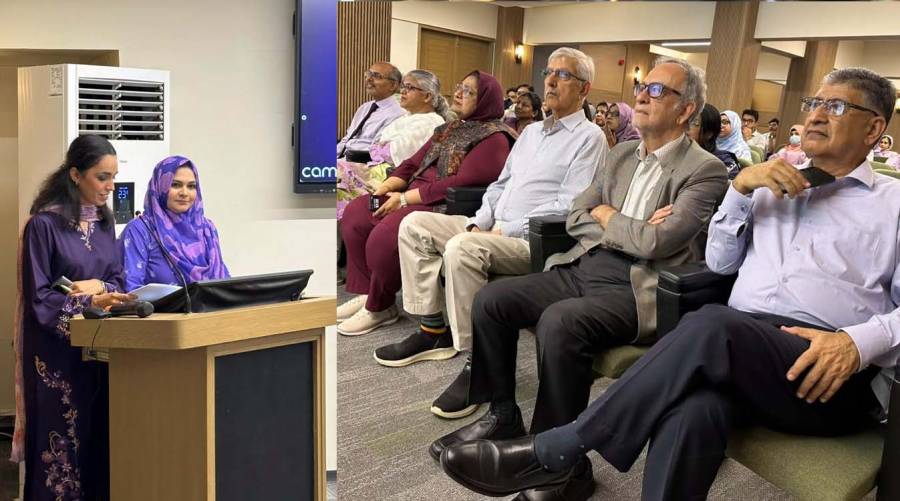
KARACHI: Doctors treating infections in Pakistan have a new locally developed digital tool designed to answer two of the most consequential questions in infectious-disease care: what is the likely bug — and what is the right drug?
Dow University of Health Sciences (DUHS) has formally launched “Bug & Drug,” an Infectious Diseases Clinical Decision Support (CDS) application developed to help healthcare professionals make timely, evidence-based treatment decisions while encouraging more rational and responsible use of antimicrobials.
Built around Pakistan’s clinical environment rather than simply reproducing an international reference guide, the app brings together guidance on 113 infectious diseases, 141 etiological agents and 75 antimicrobials. It has been designed for both inpatient and outpatient care, can work offline, and incorporates clinical algorithms, antimicrobial stewardship guidance and point-of-care calculators within a single platform. LinkedIn
The initiative arrives at a particularly important moment for Pakistan, where antimicrobial resistance (AMR), inappropriate antimicrobial use and the need for stronger stewardship remain major public-health concerns. Pakistan’s National Action Plan for Antimicrobial Resistance 2.0, covering 2024-2028, places renewed emphasis on coordinated action, surveillance and appropriate antimicrobial use. World Health Organization
Designed for the doctor at the bedside
The app was developed at the Sindh Infectious Diseases Hospital & Research Centre (SIDH&RC), Dow University of Health Sciences, through collaboration among infectious-disease physicians, clinical microbiologists and software developers.
Funding support came from the Wellcome Trust and CAMO-Net under an Antimicrobial Stewardship fellowship grant awarded to Dr Muneeba Ahsan Sayeed, Assistant Professor and Head of the Department of Infectious Diseases at SIDH&RC.
Its central proposition is deliberately simple: help clinicians identify the likely infectious organism — the “bug” — and select an appropriate “drug”, while taking the patient's condition and available clinical evidence into account.
But the application extends substantially beyond a drug directory.
It converts clinical guidance and evidence-based recommendations into structured pathways intended to take a clinician from initial assessment through diagnosis, empirical therapy, microbiology results and, where appropriate, more targeted treatment.
That could be especially relevant outside major tertiary hospitals, where continuous access to an infectious-disease specialist may not always be possible.
Nazli Hossain: specialist access remains limited
The app was formally unveiled at a launch ceremony held at the Sindh Infectious Diseases Hospital & Research Centre, with Professor Dr Nazli Hossain, Vice Chancellor of Dow University of Health Sciences, attending as chief guest and Professor Dr Mohammed Saeed Quraishy, T.I., Professor Emeritus and former Vice Chancellor of DUHS, as guest of honour.
Dr Abdul Wahid Rajput, Medical Superintendent of SIDH&RC, welcomed participants at the ceremony, which also included a demonstration of the application's workflow and presentations on its development and antimicrobial stewardship. LinkedIn
Professor Nazli Hossain said the limited number of infectious-disease specialists in Pakistan made clinical decision-support particularly relevant to smaller and secondary-care hospitals, where specialist expertise may not be available around the clock.
She said a tool capable of providing evidence-based guidance at the patient's bedside could help clinicians in those settings and pledged continued university support for the project.
The Vice Chancellor also called for a short tutorial explaining how to use the application and stressed that its clinical content should continue to be updated using data from local hospitals.
She raised a further issue that may prove critical to the app's long-term value: whether future versions should remain hospital-specific or progressively incorporate city- and region-level microbiology and resistance data.
Professor Hossain also pointed to possible applications in conditions such as puerperal sepsis, particularly within secondary-care services.
Sepsis support is one of its key functions
One of the app's most consequential areas is sepsis, where delays in recognising serious infection and starting appropriate treatment can affect outcomes.
According to DUHS and the app's official description, Bug & Drug is designed to assist clinicians with early recognition of sepsis, selection of appropriate antimicrobials and assessment of the appropriate window for initiating antibiotic therapy. Its developers say its workflow supports implementation of the one-hour sepsis bundle. Google Play
The app includes qSOFA and NEWS2 scoring tools, enabling clinicians to assess clinical deterioration and risk without moving between separate applications or calculators.
A third built-in calculator estimates creatinine clearance, an important consideration when adjusting doses of antimicrobials for patients with impaired renal function. LinkedIn
The application is intended as decision support rather than a replacement for clinical judgement or an infectious-disease specialist — an important distinction stressed by the development team.
From empirical treatment to culture-guided therapy
A particularly useful component for antimicrobial stewardship is Culture-Guided Therapy.
Once microbiology results are available, users can enter factors including the infection site, organism identified and antimicrobial susceptibility profile to obtain a prioritised treatment pathway.
The broader platform incorporates both empirical and culture-guided antimicrobial recommendations, allowing the clinician's approach to evolve as more diagnostic information becomes available. LinkedIn
That progression matters because antimicrobial stewardship is not simply about withholding antibiotics. It also involves selecting the most appropriate agent, dose, route and duration — and narrowing or changing therapy when microbiological evidence allows.
The app consequently includes guidance on intravenous-to-oral antibiotic switching, renal dose adjustment and antimicrobial spectrum, alongside the World Health Organization AWaRe classification of antibiotics. Google Play
AMR, resistance genes and infection-control guidance
Bug & Drug also includes a dedicated antimicrobial-resistance component.
Its functions cover resistant organisms, treatment considerations and targeted therapy based on detected resistance genes, while transmission-based precautions are incorporated to help clinicians consider infection-control requirements alongside drug therapy. LinkedIn
The platform additionally provides post-exposure prophylaxis guidance for relevant infections.
This gives the application a broader clinical role than a traditional antibiotic formulary: it is designed to bring diagnostic reasoning, antimicrobial choice, resistance information and infection-control considerations into the same workflow.
TB, HIV, STIs and vaccination included
The app's scope extends to major communicable-disease programmes.
Dedicated sections provide information related to tuberculosis, HIV and sexually transmitted infections, while the HIV and TB components include information intended to help link patients with treatment centres across Pakistan. Google Play
For sexually transmitted infections, the application includes guidance covering diagnosis and treatment pathways, partner management and follow-up.
A separate vaccination section contains information on vaccines, schedules, administration and relevant clinical considerations.
This breadth could make the platform useful not only for infectious-disease specialists but also for general physicians, medical officers and clinicians working in facilities where specialist infectious-disease support is limited.
Why a Pakistan-specific app matters
Dr Syed Faisal Mahmood, Section Head of Infectious Diseases at Aga Khan University, said infectious diseases present an unusually complex decision-making environment because clinicians must consider a large number of pathogens, clinical syndromes, antimicrobial options and patient-specific variables.
Aga Khan University's faculty profile identifies Dr Mahmood as an infectious-disease specialist and Section Head. Aga Khan University
At the launch, he said Bug & Drug was developed with Pakistan's organisms, diseases, clinical environment and available medicines in mind.
That local context is an important distinction.
International resources such as the Sanford Guide are widely used by clinicians, but resistance patterns, drug availability and disease epidemiology can differ substantially between countries — and even between hospitals within the same city.
The developers' longer-term challenge will therefore be to ensure that local recommendations remain current as susceptibility patterns and clinical evidence change.
Professor Nazli Hossain's emphasis on regular updates based on hospital data directly addresses that issue.
An app that is expected to keep evolving
The development team describes Bug & Drug as an evolving platform, rather than a finished static reference.
It includes a built-in bug-reporting and feedback mechanism through which users can flag possible errors, information issues or suggestions directly to the team.
That feature could become particularly important as clinicians begin using the app in different specialties, hospitals and regions.
Dr Asma Naseem, speaking at the launch, stressed that wider adoption would generate the usage experience and professional feedback needed to refine the platform. She also highlighted its potential usefulness in public-sector hospitals, where rapid access to specialist advice may be limited.
Dr Abdul Wahid Rajput, Medical Superintendent of SIDH&RC, said evidence-based clinical decision-making and responsible antimicrobial use were essential as healthcare systems confront antimicrobial resistance.
Pakistan still needs a national antibiogram
The launch also brought attention to a larger gap that an app alone cannot resolve.
Dr Izhar Hussain, Executive Director of the Institute of Biological, Biochemical and Pharmaceutical Sciences at DUHS, called for the development of a national antibiogram and standardised treatment guidance informed by Pakistan's own microbiological and resistance data. His DUHS faculty profile confirms his role as Executive Director of IBBPS.
An antibiogram summarises how frequently bacterial isolates remain susceptible or resistant to different antimicrobial agents. Reliable local antibiograms can help hospitals choose better empirical treatment while awaiting individual culture results.
Dr Hussain also stressed that antimicrobial resistance cannot be addressed only through human medicine. Antibiotic use in animals and environmental pathways form part of the same problem, requiring a broader One Health response.
That approach is consistent with Pakistan's current national AMR strategy, which frames resistance as a multisectoral challenge rather than an issue confined to hospitals.
He also highlighted another global concern: the relatively limited pipeline of new antibiotics, which increases the importance of preserving the effectiveness of medicines already available through better stewardship, surveillance and research.
‘Right drug for the right bug’
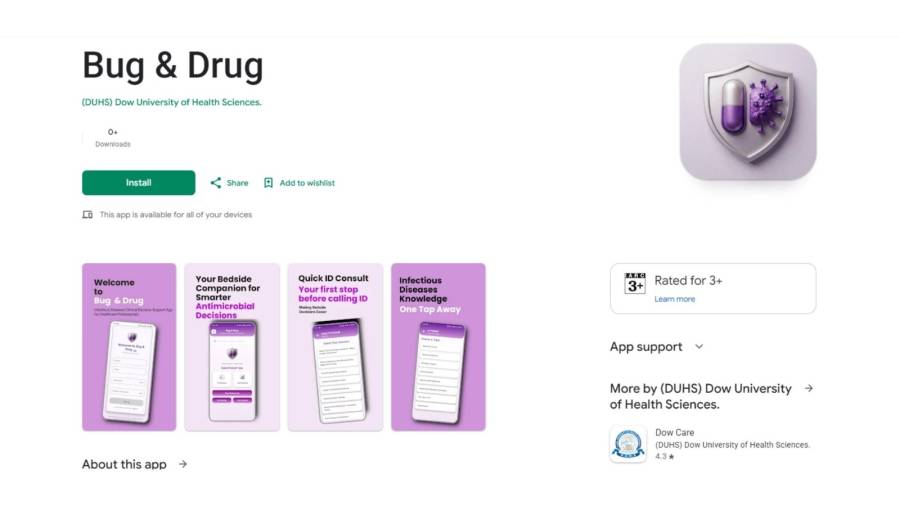
Bug & Drug on Google Play: Download
For Dr Muneeba Ahsan Sayeed, the app's purpose ultimately comes back to the concept contained in its name.
The objective is to help clinicians identify the probable or confirmed pathogen and then make a more informed antimicrobial decision — the right drug for the right bug.
The application currently combines 113 infectious diseases, 141 etiological agents and 75 antimicrobials with algorithms, bedside calculators and treatment-support tools. LinkedIn
Its practical impact, however, will depend on more than the number of conditions or medicines included.
Regular incorporation of local susceptibility data, rigorous clinical review, user feedback, continued updates and adoption by frontline clinicians will determine whether Bug & Drug can move from a promising locally developed application to a routinely useful antimicrobial-stewardship tool.
And that may be where its greatest potential lies: not in replacing the infectious-disease specialist, but in putting more structured infectious-disease expertise within reach of the doctor who does not have one standing beside them.
Stay connected with Medical News Pakistan
CLICK HERE TO JOIN the official Medical News Pakistan WhatsApp Channel for verified global medical breakthroughs, FDA approvals, healthcare innovations, clinical research updates and the latest developments shaping medicine around the world.

Advertisement
E-PAPER
Trending
Popular
Obesity linked to 229 diseases, may shorten life by 11 years, experts ...
-
Pakistan’s Dr. Misha Tanveer takes ...
04:03 PM, 16 Sep, 2026 -
Calorie deficit for weight loss: How to ...
06:00 PM, 24 Aug, 2026 -
Vaccine maker warns of wider TBE, ...
05:00 PM, 21 Aug, 2026 -
FDA authorizes first robot to draw ...
06:11 PM, 20 Aug, 2026
Follow us on Facebook
Follow us on Twitter
Copyright ©2026 Medical News. All Rights Reserved.