
Dr. Ziauddin Hospital launches robotic surgery in Karachi
The hospital has launched a robotic surgery programme after training its surgical teams, positioning the technology for minimally invasive general, cancer, colorectal, urological, gynecological and cardiac procedures.
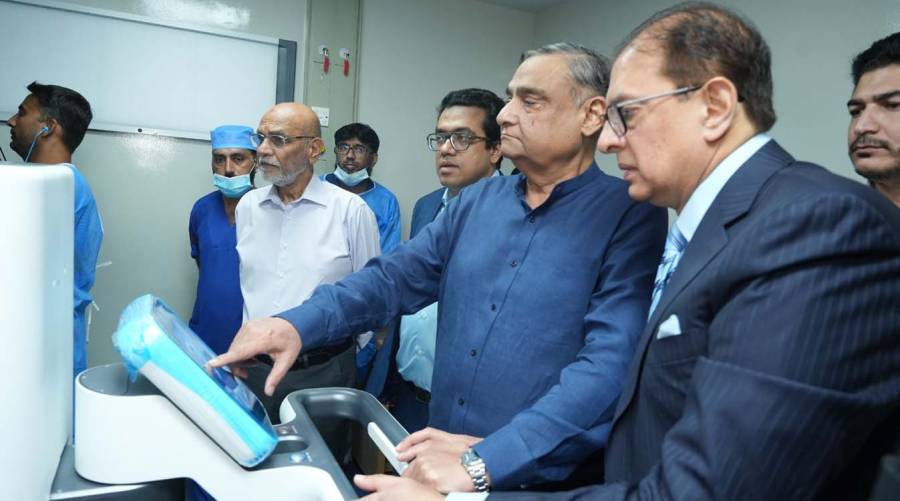
KARACHI: Dr. Ziauddin Hospital has launched its Robotic Surgery Program, expanding its surgical capabilities with technology designed to support greater precision, control and minimally invasive procedures across a range of specialties.
The programme was formally unveiled in Karachi on October 3, with hospital leadership saying the introduction of robotic-assisted surgery had been preceded by surgeon training and development of the clinical ecosystem needed to use the technology in practice.
The significance of the launch goes beyond the arrival of a new surgical platform. Dr. Ziauddin Hospital says the technology is intended to support procedures across general surgery, cancer surgery, colorectal surgery, urology, gynecology and cardiac surgery — areas where precision and minimally invasive techniques can play an important role in patient care.
‘Robotic surgery represents the future of surgical practice’
Speaking at the launch ceremony, Dr. Asim Hussain, Chairman, Dr. Ziauddin Hospital, said technological change was reshaping healthcare globally and institutions investing in advanced systems would be better placed to deliver safer procedures and improved patient experiences.
“Technology is transforming healthcare at an unprecedented pace, and robotic surgery represents the future of surgical practice worldwide,” he said.
Dr. Asim Hussain said that as surgical technologies continue to evolve, their impact will depend not only on acquisition of equipment but also on whether institutions build the expertise required to use them effectively.
He described the new programme as another step in Dr. Ziauddin Hospital’s adoption of advanced medical technology.
According to Dr. Hussain, the institution had previously been among the early adopters of several major diagnostic and interventional technologies in Pakistan, including what he described as the first CT scan in Karachi, the first superconducting MRI in Pakistan, and the first Cath Lab and Gamma Camera in the private sector.
“Today, with the launch of robotic surgery, we continue this tradition of bringing advanced technology and expertise together to deliver precision, innovation, and patient-centered surgical care,” he said.
Hospital says surgeons were trained before programme launch
One of the more important points raised during the event was that the hospital had not approached robotic surgery simply as a technology purchase.
Dr. Asim Hussain said the institution had first focused on training surgeons and developing a comprehensive robotic surgery ecosystem before formally introducing the programme.
“Technology alone does not transform healthcare; the expertise behind it does,” he said.
He added that Dr. Ziauddin Hospital had prioritised clinical preparedness so that the technology could be fully integrated into surgical practice rather than remain an isolated technological addition.
The approach, he said, reflected the hospital’s aim of ensuring that advanced technology was “not merely acquired, but fully operationalized to deliver world-class surgical care.”
That emphasis on training is particularly relevant because robotic-assisted surgery depends heavily on surgeon experience, team coordination, operating-room protocols and familiarity with the robotic platform.
From conventional surgery to robotic-assisted procedures
Dr. Ammad Hussain, Chief Executive, Dr. Ziauddin Hospital, said the introduction of robotics reflected the continuing evolution of surgery from conventional open procedures through laparoscopic techniques and now toward robotic-assisted approaches.
“The evolution of surgery from conventional and laparoscopic techniques to robotic-assisted procedures represents a significant advancement in modern healthcare,” Dr. Ammad Hussain said.
He said robotic systems can provide surgeons with greater control and accuracy while supporting improved precision during procedures.
“Today, we are not merely acquiring a new technology; we are embracing the future of surgical care,” he added.
Robotic surgery generally builds on the principles of minimally invasive surgery, with surgeons controlling specialised instruments through a robotic platform rather than manipulating conventional instruments directly at the operating table.
The technology is intended to give surgeons enhanced control and precision during procedures, although clinical outcomes depend on the type of operation, patient selection, surgeon expertise and the way the technology is integrated into care.
Six major surgical areas identified
The potential scope of the programme was outlined by Dr. Haris Rashid, Chair, Surgery, Dr. Ziauddin Hospital, who highlighted the role robotic-assisted surgery can play across multiple specialties.
He said robotic surgery had changed the standards of modern surgical care internationally by enabling increased precision and control.
According to Dr. Haris Rashid, the hospital intends to use the technology for advanced minimally invasive procedures in:
- General surgery
- Cancer surgery
- Colorectal surgery
- Urological surgery
- Gynecological surgery
- Cardiac surgery
He said the programme would give the hospital the ability to perform more complex minimally invasive procedures while aiming for improved clinical outcomes and faster recovery.
“We are proud to introduce this transformative technology to Pakistan’s private healthcare sector, enabling more advanced, minimally invasive procedures,” he said.
The range of specialties identified at the launch suggests that the programme is being developed as a hospital-wide surgical platform rather than being confined to a single department.
International experts discuss robotic advancement and precision
The launch programme also included presentations focusing on how robotic surgery is advancing internationally and how greater mechanical precision can influence surgical practice.
Professor Jim S. Khan, Consultant Surgery, University of Portsmouth, UK, addressed attendees on Robotic Advancement, discussing the continuing development of robotic-assisted surgical practice.
Mr. Altug Ergin, Vice President, MicroPort, spoke on Robotic Accuracy, focusing on precision and its role in robotic-assisted procedures.
Their participation brought both clinical and technology perspectives into a programme designed to introduce the hospital’s new surgical capability.
Why precision matters in robotic-assisted surgery
One of the recurring themes during the launch was precision.
Robotic-assisted platforms are designed to translate a surgeon’s movements into controlled instrument movements inside the patient, while offering enhanced visualisation and manoeuvrability in areas that may be difficult to access through conventional minimally invasive techniques.
The technology can potentially be particularly useful in procedures performed within confined anatomical spaces or where delicate dissection is required.
However, the hospital’s leadership repeatedly emphasised that technology alone does not determine surgical quality — a point that places surgeon training, patient selection and multidisciplinary clinical expertise at the centre of the programme.
That distinction may ultimately be more important than the machine itself.
A broader push toward minimally invasive care
Robotic surgery forms part of the wider global movement toward minimally invasive treatment.
Compared with traditional open surgery, minimally invasive approaches generally seek to reduce the size of surgical incisions and limit disruption to surrounding tissues.
Depending on the procedure and individual patient circumstances, this may contribute to benefits such as reduced postoperative discomfort, shorter recovery periods and earlier return to normal activity.
Dr. Ziauddin Hospital said its robotic surgery programme is intended to combine these minimally invasive principles with greater surgical precision and control.
‘A transformative milestone’
Delivering the closing remarks, Prof. Dr. Abbas Zafar, Dean, Faculty of Health Sciences, Ziauddin University, described the launch as an important development both for the hospital and for healthcare in Pakistan.
“The launch of robotic surgery marks a transformative milestone for Dr. Ziauddin Hospital and the healthcare sector of Pakistan,” Prof. Dr. Abbas Zafar said.
He said combining advanced surgical technology with clinical expertise could help enhance precision, improve patient outcomes and establish new standards in modern healthcare.
The comments echoed a central message repeated throughout the launch: the hospital is positioning robotic surgery not as a standalone technological showcase, but as part of a broader model integrating equipment, trained clinicians and surgical expertise.
Stay connected with Medical News Pakistan
CLICK HERE TO FOLLOW the official Medical News Pakistan WhatsApp Channel for verified global medical breakthroughs, FDA approvals, healthcare innovations, clinical research updates, public-health developments and important medical news affecting Pakistan and the world.

Advertisement
E-PAPER
Trending
Popular
Scientists discover new human blood group after solving 50-year ...
-
Dow launches ‘Bug & Drug’ app to ...
03:48 PM, 30 Sep, 2026 -
Obesity linked to 229 diseases, may ...
05:28 PM, 21 Sep, 2026 -
Pakistan’s Dr. Misha Tanveer takes ...
04:03 PM, 16 Sep, 2026 -
Calorie deficit for weight loss: How to ...
06:00 PM, 24 Aug, 2026
Follow us on Facebook
Follow us on Twitter
Copyright ©2026 Medical News. All Rights Reserved.