
Pakistan’s Dr. Misha Tanveer takes air pollution research to Europe with $20,000 funding
DUHS researcher presents work on air pollution, respiratory health and lung-related biomarkers at major European scientific conferences

KARACHI: From researching the health effects of polluted air in Karachi to presenting her work before international scientific audiences in Europe, Dr. Misha Tanveer has reached a series of important academic milestones, including $20,000 in research funding for work related to air pollution and respiratory health.
The researcher, who serves as a Lecturer in the Department of Physiology at Dow International Medical College (DIMC), Dow University of Health Sciences (DUHS), represented Pakistan-based research at major scientific gatherings in Europe during August and September 2026.
From Karachi’s air pollution problem to European research platforms
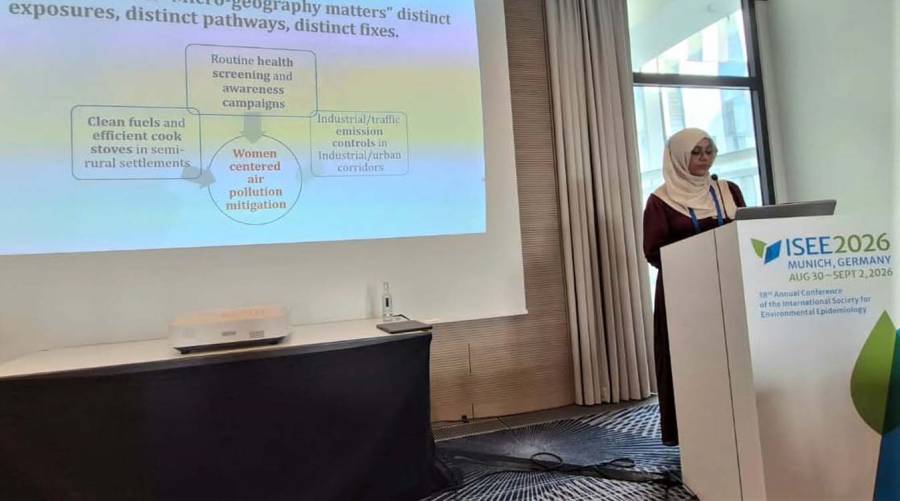
Dr. Tanveer’s research focuses on the intersection of air pollution, respiratory health and epigenetics. Her official DUHS profile lists air pollution and respiratory health among her research interests and identifies ongoing research examining the impact of air quality on women’s respiratory health in Karachi, Pakistan.
That research focus took her to the International Society of Environmental Epidemiology (ISEE) Annual Conference 2026 in Munich, Germany, where she delivered an oral presentation on the health impacts of air pollution, according to information shared by DUHS.
An oral presentation at an international scientific meeting gives researchers an opportunity to present their findings directly to an audience working in environmental epidemiology, public health and related fields.
A second international platform in Barcelona
The research journey continued in Spain, where Dr. Tanveer presented a scientific poster at the European Respiratory Society (ERS) Congress 2026 in Barcelona.
Her presentation focused on the relationship between air pollution exposure and respiratory health, including areas involving lung function and inflammatory biomarkers, according to the university's announcement.
The European Respiratory Society’s 2026 listings also include Misha Tanveer among its award recipients, adding another international dimension to her participation in the respiratory research community.
She also received ERS sponsorship to attend the congress, according to the DUHS announcement.
$20,000 research funding adds another major milestone
Beyond the European conference platforms, Dr. Tanveer was selected for the Supporting Women in Science Fellowship Program, associated with Aga Khan University and the University of Oxford, and received $20,000 in research funding for work examining air pollution-related respiratory health effects and epigenetic changes, according to the university.
The funding element is particularly relevant to her research trajectory because it supports work linking environmental exposure with biological changes and respiratory health.
Aga Khan University’s Supporting Women in Science programme has featured Dr. Tanveer’s research. Its 2025 conference programme listed Misha Tanveer (DUHS) for a presentation on DNA methylation and respiratory health, placing her work within a broader research programme examining environmental and biological determinants of health.
Her research connects pollution with biological effects
Dr. Tanveer’s academic work goes beyond documenting exposure to polluted air. Her stated research interests include epigenetics, a field concerned with biological changes that can influence how genes function without changing the underlying DNA sequence.
Her DUHS profile lists MBBS and M.Phil in Physiology among her qualifications, with a PhD in Physiology ongoing. It also identifies her current research on air quality and women’s respiratory health in Karachi.
This focus gives her research a distinctly local dimension: Karachi provides the setting for investigating how air quality may affect respiratory health, while the research is being presented within international environmental and respiratory-health forums.
Building an international research profile
Dr. Tanveer is also part of the teaching and academic environment at DIMC, where DUHS identifies her as a Lecturer and Deputy Coordinator for First Year MBBS, as well as coordinator of the Green Youth Movement at DIMC.
Her published research record includes peer-reviewed work in areas such as chronic illness and immune dysregulation, while her current research interests increasingly centre on air pollution, respiratory health and epigenetic changes.
Taken together, her appearances at the ISEE Annual Conference in Munich and the ERS Congress in Barcelona, alongside the $20,000 research funding, represent a notable period in the career of a Pakistan-based researcher working on an increasingly important environmental-health question.
DUHS congratulated Dr. Tanveer on the achievements and her representation of the university at international scientific platforms.
For a researcher studying something as widespread and difficult to escape as air pollution, the significance of the work lies not only in taking Pakistani research to international conferences, but also in building the evidence needed to better understand how polluted air can affect lungs, respiratory function and human health.
Stay connected with Medical News Pakistan
CLICK HERE TO JOIN the official Medical News Pakistan WhatsApp Channel for verified global medical breakthroughs, FDA approvals, healthcare innovations, clinical research updates and the latest developments shaping medicine around the world.

Advertisement
E-PAPER
Trending
Popular
Pakistan’s Dr. Misha Tanveer takes air pollution research to Europe ...
-
Calorie deficit for weight loss: How to ...
06:00 PM, 24 Aug, 2026 -
Vaccine maker warns of wider TBE, ...
05:00 PM, 21 Aug, 2026 -
FDA authorizes first robot to draw ...
06:11 PM, 20 Aug, 2026 -
One blood test for multiple cancers ...
04:52 PM, 11 Aug, 2026
Follow us on Facebook
Follow us on Twitter
Copyright ©2026 Medical News. All Rights Reserved.