
Seven batches of six widely used medicines declared counterfeit
Laboratory tests found no stated active ingredients in identified batches of Velosef, Augmentin, No-Spa Forte, Mucaine, Brexin and Laxoberon. Manufacturers have disowned the questioned products, while DRAP has issued alerts and directed authorities to seize specified counterfeit batches.
KARACHI: Seven batches of six widely used medicines, including two commonly prescribed antibiotics, have been declared counterfeit by the Sindh Drug Testing Laboratory after tests found that the samples lacked their stated active pharmaceutical ingredients, raising serious concerns about patient safety and the possible circulation of falsified medicines in Pakistan.
The affected products include Velosef 500mg capsules, Augmentin 625mg tablets, No-Spa Forte 80mg tablets, Mucaine suspension, Brexin tablets and Laxoberon liquid. The findings cover specific batches of these medicines, not every product sold under the respective brand names.
Adnan Rizvi, Director of the Sindh Drug Testing Laboratory, said the identified batches had been declared counterfeit under the Drugs Act, 1976. Laboratory analysis found that the samples did not contain the active ingredients required to produce their stated therapeutic effects.
The companies associated with all six brands have denied manufacturing the questioned batches, according to Rizvi. In the case of Laxoberon, Martin Dow Marker informed the authorities in writing that it had not produced the identified batches.
The laboratory reports have been forwarded to the Secretary of the Sindh Quality Control Board and the Provincial Drug Inspector for Karachi South for legal proceedings under the Drugs Act, 1976. Reports concerning the two Laxoberon batches have also been referred to the relevant provincial quality-control authorities.
Which medicines, batches have been declared counterfeit?
The laboratory findings cover seven batches across six medicines used for bacterial infections, abdominal pain, gastric complaints, inflammation and constipation.
The affected products and batch numbers identified in the information provided to Medical News Pakistan are:
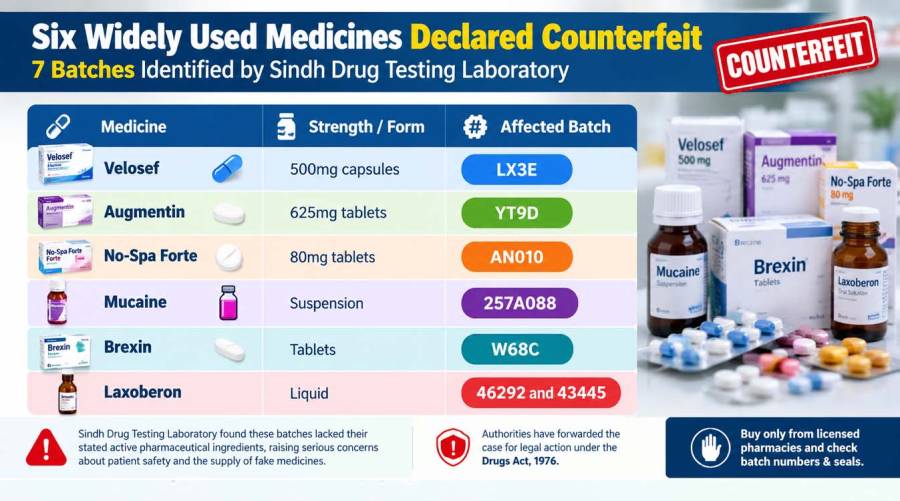
The laboratory's central finding was that the tested samples did not contain the active ingredients stated on their packaging. This means that patients taking the identified products could receive little or none of the intended treatment despite using medicines that appear to carry the names of established pharmaceutical brands.
Antibiotics without their active ingredients raise treatment concerns
Two of the affected medicines, Velosef and Augmentin, are antibiotics used to treat bacterial infections.
Velosef 500mg contains cefradine, while Augmentin 625mg combines amoxicillin and clavulanic acid. The laboratory findings identified the absence of the respective active ingredients in the questioned batches.
The absence of these ingredients means that the products cannot be relied upon to provide their intended antibacterial treatment. Patients with bacterial infections who unknowingly take such medicines may experience treatment failure, worsening illness or delays in receiving effective therapy.
The concern is particularly important for antibiotics because an apparent course of treatment may give patients a false sense that their infection is being treated when the medicine is not delivering the required therapeutic effect.
Stomach medicines, painkiller and laxative also affected
The findings also cover medicines used for abdominal pain, gastric complaints, inflammation and constipation.
No-Spa Forte 80mg is used to relieve abdominal pain and spasms. Its active ingredient is drotaverine hydrochloride, which was not detected in the tested sample.
Mucaine suspension is used for acidity and other gastric complaints. Its formulation includes oxethazaine, aluminium hydroxide and magnesium hydroxide. The laboratory declared the identified sample counterfeit after the stated active ingredients were not detected.
Brexin is prescribed for pain and inflammation, including conditions affecting the joints. Its active ingredient is piroxicam beta-cyclodextrin. The relevant laboratory finding was that the tested sample lacked the declared ingredient.
The two affected Laxoberon liquid batches, numbered 46292 and 43445, were also found to lack sodium picosulfate, the active ingredient responsible for the medicine's laxative effect.
For patients using these medicines, the absence of the stated ingredients could mean that pain, abdominal discomfort, acidity or constipation remains untreated despite taking what appears to be the prescribed medication.
Manufacturers deny producing the questioned batches
The companies associated with the six medicines have denied manufacturing the identified batches, raising concerns that counterfeit products bearing the names of established pharmaceutical brands may have entered the medicine supply chain.
According to the laboratory information, Martin Dow Marker, associated with Laxoberon, formally informed the authorities that it had not manufactured the two questioned batches.
The companies associated with the other five brands also denied producing the identified products. These responses are significant because the products carried the names of established brands despite the manufacturers' rejection of the questioned batches.
The findings do not, however, establish how the products were manufactured, where they entered the supply chain or who was responsible for their distribution. Those questions remain matters for regulatory investigation.
DRAP issues alerts and directs seizure of counterfeit medicines
The Drug Regulatory Authority of Pakistan (DRAP) has issued rapid alerts concerning several of the affected medicines, reinforcing the need for action across the pharmaceutical supply chain.
According to the DRAP Rapid Alert No. I/S/10-26-43 concerning the identified batches of Velosef 500mg capsules (LX3E), Augmentin 625mg tablets (YT9D), No-Spa Forte 80mg tablets (AN010) and Mucaine suspension (257A088).
The alert records that the Sindh Drug Testing Laboratory declared the samples spurious or falsified under Section 3(z-b)(i) and (ii) of the Drugs Act, 1976, after the manufacturers disowned them and laboratory analysis failed to identify the declared active ingredients.
DRAP identified GlaxoSmithKline Pakistan Limited as the company purportedly named on the packaging of Velosef and Augmentin, Hoechst Pakistan Limited in the case of No-Spa Forte, and Lucky Core Industries Limited for Mucaine.
The regulator warned that use of the identified products could result in treatment failure and pose risks to patient safety. It directed its regulatory field force and provincial drug control departments to conduct surveillance throughout the supply chain and confiscate the falsified products.
A separate Rapid Alert No. I/S/10-26-44 concerned Brexin tablets. DRAP identified batch W68C, stating that the sample did not contain its declared active ingredient, piroxicam beta-cyclodextrin. The product was purportedly manufactured by GlaxoSmithKline Pakistan Limited under licence from Chiesi Farmaceutici S.p.A., Italy, but the manufacturer disowned the sample.
Why counterfeit medicines pose a serious public-health risk
Medicines without their declared active ingredients can fail to treat the conditions for which they are prescribed. This can expose patients to prolonged illness, uncontrolled symptoms and delays in receiving appropriate treatment.
For bacterial infections, the consequences can be particularly serious when patients unknowingly rely on ineffective antibiotics instead of receiving medicines that can treat the infection.
Similarly, patients taking counterfeit medicines for pain, inflammation, gastric complaints or constipation may continue to experience symptoms while believing they are receiving effective treatment.
The problem also undermines confidence in legitimate pharmaceutical brands and the wider medicine supply chain. Counterfeit products can carry the names and packaging of established manufacturers, making it difficult for consumers to identify them through appearance alone.
What patients and pharmacies should do
DRAP has advised consumers not to use the specific products and batches identified in its alerts. Anyone who has taken an affected product and experienced a problem should contact their physician or healthcare provider and report the incident to DRAP or the National Pharmacovigilance Centre.
Consumers should obtain medicines only from licensed pharmacies and authorised retail outlets. Pharmacists and healthcare facilities should check their inventories against the affected product names and batch numbers and remain vigilant about the authenticity of medicines received through distributors and suppliers.
Patients who are unsure whether a medicine they have purchased belongs to an affected batch should consult a licensed pharmacist or healthcare professional rather than relying on the brand name or packaging alone.
DRAP's alerts also direct healthcare professionals to report adverse events and product-quality concerns through the national or provincial pharmacovigilance system.
Distribution and patient impact remain unclear
Despite the laboratory findings and regulatory alerts, several important questions remain unanswered.
Authorities have not disclosed the quantities of the identified batches that may have reached pharmacies or other outlets, the locations where they were distributed, or whether patients have suffered harm after using the products.
The investigations and regulatory proceedings will be important in determining how the questioned medicines entered the supply chain, identifying those responsible and preventing further circulation.
The findings underline the importance of effective drug surveillance, timely enforcement and reliable supply-chain controls to protect patients from medicines that carry familiar brand names but may contain none of the ingredients needed to treat their conditions.
Stay informed with Medical News Pakistan
CLICK HERE TO FOLLOW Medical News Pakistan's official WhatsApp channel for verified healthcare developments, medicine safety alerts, medical innovations, clinical research and important public-health updates.

Advertisement
E-PAPER
Trending
Popular
37 AKU researchers join world's top 2% scientists list for 2026
-
Could a heart calcium scan reveal your ...
01:36 PM, 13 Oct, 2026 -
One blood test, 50+ cancers: What the ...
05:27 PM, 12 Oct, 2026 -
WHO rules out weight-loss drugs for ...
04:38 PM, 9 Oct, 2026 -
Global life expectancy rebounds, but ...
03:17 PM, 5 Oct, 2026
Follow us on Facebook
Follow us on Twitter
Copyright ©2026 Medical News. All Rights Reserved.