
How Pakistan-China's $850m pharma deal could change healthcare in Pakistan
The $850 million agreements go beyond investment figures, potentially accelerating local medicine and vaccine production, reducing reliance on imports, strengthening healthcare manufacturing and advancing Pakistan-China cooperation under CPEC 2.0.
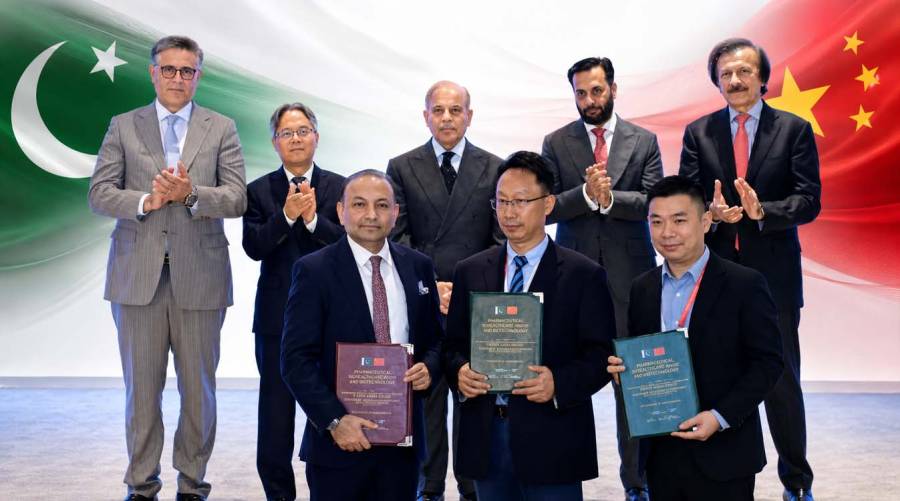
ISLAMABAD: Pakistan's pharmaceutical and healthcare sector could be on the verge of a major transformation following the signing of $850 million worth of agreements between Pakistani and Chinese companies, a development that experts believe could strengthen local medicine production, accelerate vaccine manufacturing and reduce the country's long-standing dependence on imported pharmaceutical ingredients.
The agreements emerged from the Pakistan-China Pharmaceutical and Healthcare Business-to-Business (B2B) Investment Conference, where government officials, industry leaders and investors from both countries agreed on projects spanning pharmaceuticals, biotechnology, medical devices, clinical research and healthcare manufacturing.
Rather than representing a routine investment announcement, the conference signals a broader shift in Pakistan-China economic cooperation, with healthcare becoming one of the strategic sectors expected to play a larger role under the next phase of the China-Pakistan Economic Corridor (CPEC) 2.0.
What was agreed?
According to Federal Minister for National Health Services, Regulations and Coordination Mustafa Kamal, the two-day conference concluded with 16 commercial contracts and 80 memorandums of understanding (MoUs) signed between Pakistani and Chinese companies.
The agreements comprise approximately $600 million in commercial contracts and $250 million in MoUs, bringing the total value of announced commitments to $850 million.
Among them are 18 agreements covering herbal medicines and Traditional Chinese Medicine (TCM), reflecting growing interest in expanding cooperation across multiple segments of healthcare.
The conference also brought together 146 Chinese companies represented by around 220 delegates and more than 200 Pakistani pharmaceutical, healthcare and biotechnology companies, making it one of the largest Pakistan-China business engagements in the sector.
Why this matters for Pakistan's healthcare system
Pakistan imports a significant proportion of the raw materials required to manufacture medicines domestically.
According to Mustafa Kamal, approximately 90% of the pharmaceutical raw materials, also known as Active Pharmaceutical Ingredients (APIs), used by Pakistan's pharmaceutical industry are imported.
That dependence exposes the country to global supply chain disruptions, exchange rate fluctuations and rising production costs.
Officials said agreements with Chinese companies aim to establish domestic manufacturing of pharmaceutical raw materials, helping strengthen supply chains while supporting the long-term development of Pakistan's pharmaceutical industry.
If successfully implemented, greater local production could improve medicine availability and reduce manufacturing costs, although retail prices will continue to depend on regulatory approvals and broader market conditions.
Could Pakistan begin producing more vaccines at home?
Another major focus of the conference was vaccine manufacturing.
Pakistan currently imports 13 different vaccines, making immunization programmes heavily dependent on foreign suppliers.
Health ministry officials warned that Pakistan's vaccine import bill could reach $1.2 billion by 2030 if domestic production capacity is not developed.
As a result, local vaccine manufacturing has become a strategic priority.
Officials said discussions with Chinese companies focused on establishing vaccine production facilities in Pakistan, which could improve national health security, strengthen emergency preparedness and reduce long-term dependence on imports.
Medical devices, biotechnology and research also in focus
The agreements extend beyond medicines.
Discussions also covered local manufacturing of medical devices, expansion of biotechnology, promotion of clinical trials, pharmaceutical research and vocational training for the healthcare industry.
Greater collaboration in these areas could help Pakistan develop a more integrated healthcare manufacturing ecosystem while creating skilled employment opportunities and encouraging technology transfer.
Traditional Chinese Medicine also featured prominently during the conference, with 18 agreements signed to explore collaboration in herbal medicines and related healthcare products.
Regulatory reforms aim to attract investment
Alongside the investment announcements, the government highlighted reforms designed to improve Pakistan's pharmaceutical business environment.
Mustafa Kamal said that more than 80% of the services provided by the Drug Regulatory Authority of Pakistan (DRAP) have now been digitalized, allowing pharmaceutical companies to complete licensing procedures online.
According to the minister, medicine licences can now be issued within 20 days after registration, significantly reducing processing times.
He also noted that Pakistan's pharmaceutical regulatory framework has gained greater international credibility following the World Health Organization's (WHO) prequalification of local drug testing laboratories.
Healthcare becomes part of CPEC 2.0
Speaking at the conference, Prime Minister Shehbaz Sharif described the agreements as another important milestone in expanding Pakistan-China industrial cooperation under CPEC 2.0.
Unlike the first phase of CPEC, which primarily focused on infrastructure, transport and energy projects, the second phase places greater emphasis on industrial collaboration, manufacturing, technology transfer and innovation.
The Prime Minister said the agreements would encourage partnerships in the co-production of medicines, vaccines and other life-saving healthcare products while opening new opportunities for investment and industrial development.
Prime Minister's Special Assistant on Industries and Production Haroon Akhtar Khan said the conference focused on six strategic sectors: active pharmaceutical ingredients, biotechnology and vaccines, medical devices, generic medicines and injectables, clinical trials and research, and herbal medicines.
Meanwhile, Chinese Ambassador to Pakistan Jiang Zaidong reaffirmed China's commitment to expanding industrial and investment cooperation, expressing confidence that deeper business engagement would strengthen the all-weather strategic cooperative partnership between the two countries.
The real measure of success will be implementation
While the agreements represent one of the largest healthcare investment commitments announced between Pakistan and China, experts note that their long-term impact will depend on how quickly projects move from signed documents to operational manufacturing facilities.
If implemented successfully, the initiatives could help Pakistan expand domestic production of medicines, vaccines and healthcare technologies, strengthen pharmaceutical exports, create skilled jobs and improve resilience against future global supply chain disruptions.
For Pakistan's healthcare sector, the conference may ultimately be remembered not for the $850 million announced—but for whether it delivers lasting improvements in access to medicines, local manufacturing capacity and healthcare innovation.
Stay informed, stay alert!
CLICK HERE TO JOIN Medical News Pakistan on WhatsApp for real-time health alerts, expert insights, and breakthrough medical discoveries.

Advertisement
E-PAPER
Trending
Popular
Pakistan’s Dr. Misha Tanveer takes air pollution research to Europe ...
-
Calorie deficit for weight loss: How to ...
06:00 PM, 24 Aug, 2026 -
Vaccine maker warns of wider TBE, ...
05:00 PM, 21 Aug, 2026 -
FDA authorizes first robot to draw ...
06:11 PM, 20 Aug, 2026 -
One blood test for multiple cancers ...
04:52 PM, 11 Aug, 2026
Follow us on Facebook
Follow us on Twitter
Copyright ©2026 Medical News. All Rights Reserved.