
FDA authorizes first robot to draw blood without hands-on needle insertion
The Aletta robotic blood-draw system can locate a vein, apply a tourniquet, disinfect the skin, insert and discard the needle, switch collection tubes and place a bandage — while one trained phlebotomist supervises up to three devices.
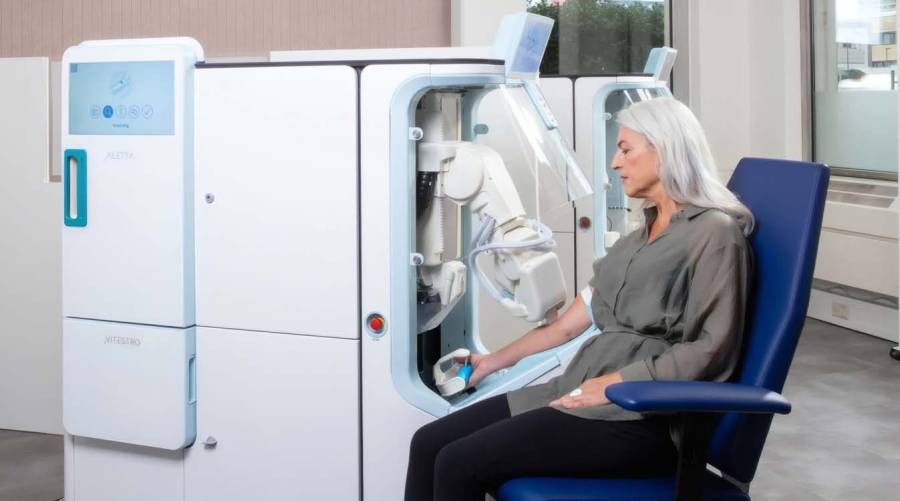
WASHINGTON: A routine blood test could be entering a new era after the U.S. Food and Drug Administration authorized the first standalone robotic device capable of drawing blood from a patient's arm without hands-on needle insertion by an operator.
The device, called Aletta, autonomously performs most of the steps normally carried out by a phlebotomist — from finding a suitable vein to inserting the needle, changing blood collection tubes and applying a bandage when the draw is complete.
But this is not an unsupervised robot replacing healthcare workers entirely.
Aletta has been authorized for adult patients in outpatient settings and must operate under the oversight of a professional trained in phlebotomy. A trained supervisor starts each session, remains available if problems arise and performs key checks after collection.
What makes the authorization particularly significant is scale: according to the FDA, one phlebotomist can supervise as many as three Aletta devices simultaneously.
That could turn one of medicine's most common procedures into an important test case for how automation may be deployed in everyday patient care.
How a robot finds the vein before inserting a needle
Aletta does not simply position a needle at a predetermined point.
After the patient places an arm in the device, the system uses near-infrared light and Doppler ultrasound to identify an appropriate vein and distinguish veins from arteries.
That distinction is central to the safety of automated venipuncture.
If the system cannot identify a suitable vein, it does not attempt the needle insertion.
Once a vein has been selected, Aletta can proceed through the blood-draw workflow automatically.
The system can:
- apply the tourniquet,
- prepare and disinfect the skin,
- identify an appropriate vein,
- insert the needle,
- collect blood,
- change collection tubes,
- dispose of the needle, and
- apply a bandage.
For patients accustomed to watching a clinician perform each of these tasks manually, the degree of automation represents a striking change.
And the technology has already been tested against the people who currently perform the procedure.
FDA says successful draws compared well with human phlebotomists
The FDA said its authorization was supported by clinical data showing that when Aletta proceeds with a needle stick, its successful blood-draw rates were comparable to or better than those achieved by trained human phlebotomists.
The evaluation included a broad patient population.
According to the agency, testing included individuals with:
- different health conditions,
- varying skin tones, and
- self-reported difficult vein access.
Those details matter because automated vein-finding technology would have limited clinical value if it only worked reliably in patients with easily visible or accessible veins.
The FDA also said device-related adverse events were uncommon and mild.
Still, several safeguards are built into the system because blood collection is not risk-free.
What happens if a patient suddenly moves?
Patient movement is one of the obvious challenges for a robot performing venipuncture.
Aletta is designed to react automatically.
If a patient moves excessively during the procedure, the needle automatically detaches and the blood draw stops, according to the FDA.
Additional onboard sensors can also identify unsafe conditions, pause the procedure and alert the supervising phlebotomist.
The system continuously applies disinfectant to the skin during the ultrasound scan, while trained staff are responsible for cleaning the device between patients.
These safeguards help explain why the FDA authorization does not remove healthcare professionals from the workflow.
Instead, it changes their role.
The phlebotomist still has important responsibilities
Aletta may perform the physical blood draw, but a trained phlebotomist continues to oversee the procedure.
The supervisor initiates the session and must be available to intervene if needed.
After collection, the phlebotomist also confirms that blood tubes have been filled in the proper order and contain adequate sample volumes.
That distinction is important when interpreting headlines describing Aletta as an autonomous blood-draw robot.
It is autonomous in performing the venipuncture workflow once the procedure has been initiated, but the FDA has authorized it as a supervised medical device, not as a completely independent replacement for clinical staff.
That supervision model may actually be one of the technology's biggest advantages.
One phlebotomist could supervise three blood-draw robots
The FDA specifically highlighted the potential workforce implications.
Blood collection is one of the most commonly performed medical procedures, yet the United States is facing pressure from a shortage of trained phlebotomists.
By allowing a single professional to supervise up to three Aletta systems at the same time, the technology could potentially increase the number of patients served without requiring one clinician to perform every needle insertion personally.
FDA Center for Devices and Radiological Health Director Dr. Michelle Tarver said the authorization reflects efforts to advance technologies that respond to an important public-health need while maintaining patient safety and effectiveness.
The agency noted that staffing shortages can contribute to delays in accessing even basic diagnostic services such as blood testing.
If robotic blood collection proves practical at scale, it could affect hospital laboratories, outpatient centers, diagnostic facilities and other high-volume testing environments.
But whether patients and healthcare systems embrace robotic venipuncture is another question.
Would patients trust a robot with the needle?
The technical ability to draw blood is only part of the challenge.
Venipuncture can already cause anxiety for patients who dislike needles, have previously experienced difficult blood draws or worry about pain and failed attempts.
A robotic system introduces an additional psychological factor: the needle is being positioned and inserted by a machine.
For some patients, imaging-guided automation could be reassuring, particularly if it improves consistency.
For others, the absence of a healthcare worker physically performing the procedure may initially feel uncomfortable.
Real-world adoption will therefore depend not only on successful-stick rates, but also on:
- patient confidence,
- comfort and pain,
- speed of collection,
- failure and repeat-stick rates,
- workflow efficiency,
- device cost,
- maintenance requirements, and
- how easily the system fits into busy clinics.
The FDA authorization answers the regulatory question of whether the device can enter the U.S. market under its authorized conditions.
It does not yet answer all of those practical questions.
The FDA used its De Novo pathway
The agency granted marketing authorization to Aletta's developer, Vitestro, through the FDA's De Novo pathway.
That pathway is used for novel medical devices considered low to moderate risk when there is no existing legally marketed device of the same type that can serve as a predicate.
The authorization also establishes a new regulatory framework for this category of device.
The FDA said special controls will include requirements related to areas such as:
- labeling,
- performance testing, and
- clinical testing.
Combined with existing general device controls, these requirements are intended to provide reasonable assurance of safety and effectiveness.
That means Aletta's authorization could matter beyond this particular product.
It effectively creates a regulatory route that future automated blood-draw technologies may have to follow.
Why automated blood collection could matter beyond the US
Although the authorization applies to the United States, the technology raises much broader questions for healthcare systems around the world.
Blood samples underpin an enormous share of modern diagnosis and disease monitoring, including:
- complete blood counts,
- kidney and liver function tests,
- diabetes monitoring,
- infection testing,
- hormone studies,
- cancer-related laboratory testing, and
- therapeutic drug monitoring.
The collection step may seem routine, but failed venipuncture can delay testing, increase patient discomfort and consume staff time.
Countries facing healthcare-worker shortages may therefore watch automated blood-draw technologies closely.
For markets such as Pakistan, however, affordability would be a critical consideration.
The clinical usefulness of a robotic phlebotomy system would ultimately depend on whether improvements in staffing efficiency and successful collection justify equipment, maintenance and training costs.
No pricing information was provided in the FDA announcement.
A bigger shift toward robots performing clinical procedures?
Medical robots are already used in areas ranging from surgery and rehabilitation to pharmacy automation and hospital logistics.
But autonomous needle placement moves robotics into an especially familiar and frequent patient interaction.
That makes Aletta notable beyond phlebotomy.
The device combines medical imaging, automated decision-making, robotics, sensors and procedural automation to perform a task traditionally dependent on direct human dexterity.
If the model succeeds, similar technology could eventually influence how healthcare systems approach other repetitive, image-guided procedures.
For now, however, the authorization remains specifically limited.
Aletta is approved for adults in outpatient settings and under trained phlebotomy supervision.
It is not an authorization for unsupervised home blood collection, pediatric use or fully autonomous operation without a qualified professional overseeing the procedure.
The real test begins after authorization
The headline is striking: a robot can now legally perform an automated blood draw in the United States.
But the more consequential story may unfold after deployment begins.
Clinical performance will now meet the realities of everyday healthcare — nervous patients, difficult veins, busy clinics, workflow pressures and staff who must learn how to integrate a robotic system into established routines.
If Aletta delivers on its promise, one phlebotomist overseeing three simultaneous robotic draws could significantly change the economics and staffing of high-volume blood collection.
If patients resist the technology or workflows prove cumbersome, adoption could be much slower.
Either way, the FDA authorization establishes an important milestone.
For the first time, a standalone robotic blood-draw device capable of locating a vein and carrying out the needle procedure without hands-on operator intervention has received U.S. marketing authorization.
And for one of healthcare's oldest and most routine procedures, that could be the beginning of a much larger automation story.
Stay connected with Medical News Pakistan
CLICK HERE TO JOIN the official Medical News Pakistan WhatsApp Channel for verified global medical breakthroughs, FDA approvals, healthcare innovations, clinical research updates and the latest developments shaping medicine around the world.

Advertisement
E-PAPER

Trending
Popular
Pakistan’s Dr. Misha Tanveer takes air pollution research to Europe ...
-
Calorie deficit for weight loss: How to ...
06:00 PM, 24 Aug, 2026 -
Vaccine maker warns of wider TBE, ...
05:00 PM, 21 Aug, 2026 -
FDA authorizes first robot to draw ...
06:11 PM, 20 Aug, 2026 -
One blood test for multiple cancers ...
04:52 PM, 11 Aug, 2026
Follow us on Facebook
Follow us on Twitter
Copyright ©2026 Medical News. All Rights Reserved.

