
PMDC puts Mirpurkhas medical college on notice after Fahmeeda case
After the death of Mirpurkhas medical student Fahmeeda Laghari, Pakistan’s top regulator has signaled possible action against those responsible — and against any institution that treated student safety as a formality.
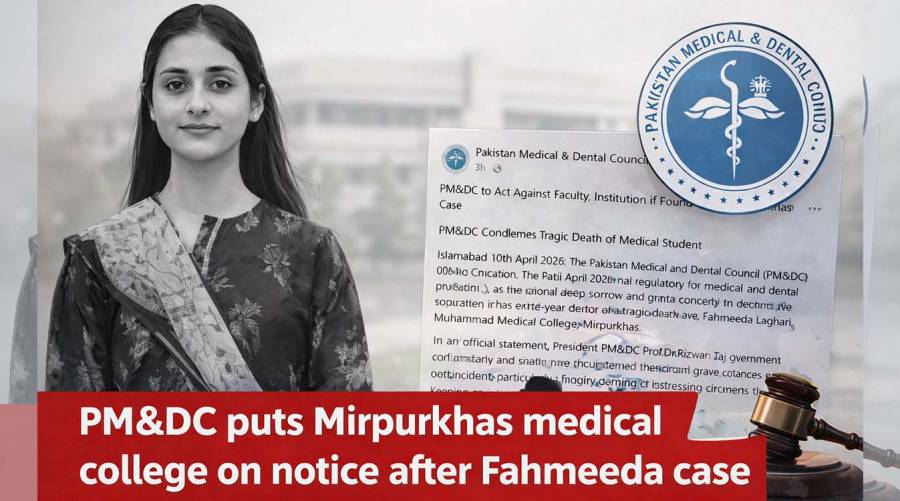
KARACHI: When Pakistan’s top medical education regulator publicly warns that harassment safeguards are not a formality, it means a tragedy has crossed a dangerous threshold.
The death of third-year medical student Mrs. Fahmeeda d/o Intizar Hussain Laghari of Muhammad Medical College, Mirpurkhas is now no longer just a police case, a family’s cry for justice, or a local institutional controversy. With the Pakistan Medical and Dental Council (PMDC) formally stepping in, the case has become something much bigger: a national stress test of whether medical colleges in Pakistan are genuinely protecting students — or merely claiming that they are.
On 10 April 2026, PMDC issued a formal statement expressing deep sorrow and grave concern over Fahmeeda Laghari’s death and the serious allegations surrounding it. In the statement, President PMDC Prof. Dr. Rizwan Taj strongly condemned the circumstances of the incident, particularly the harassment-related claims, and described the loss of a young medical student under such distressing conditions as deeply alarming.
Related story: What led to Mirpurkhas medical student’s tragic death? Committee investigates
That intervention matters because it changes the center of gravity of the story.
Until now, the case had already escalated through police channels and public pressure. But PMDC’s language signals something even more consequential: this is now a regulatory accountability matter as well. The Council has asked for the complete record in the case, including the circumstances of the incident, detailed findings of the inquiry committee constituted by the institution and government, and the remedial measures undertaken by the institution. It has further stated that, once the material is received, the matter will be referred to the PMDC Disciplinary Committee for appropriate action against the responsible persons.
That is a major shift. It means the fallout, if the allegations are substantiated, may not remain confined to an FIR, a police report, or a single criminal investigation. It may move into the regulatory domain where questions of institutional compliance, faculty responsibility, and college governance become impossible to avoid.
Related story: Father alleges harassment, blackmail behind Mirpurkhas medical student death; five booked
PMDC has gone further still.
Prof. Dr. Rizwan Taj emphasized that any failure to implement PMDC’s directives or to provide a safe academic environment would amount to a violation of PMDC regulations and policies. He underlined that harassment committees in medical and dental institutions are not a ceremonial requirement but a critical safeguard for students, and that negligence in this regard would invite strict regulatory action.
That single message may become the most important line in the entire national conversation.
Because if this case shows that complaints were ignored, warning signs were missed, or anti-harassment mechanisms existed only on paper, then the Mirpurkhas tragedy stops being a single-campus incident. It becomes evidence of a wider disease in Pakistan’s medical education system.
To understand why this has become such a high-stakes case, the full timeline matters.
The first official development came through a signed order issued on 9 April 2026 by the Deputy Inspector General of Police, Mirpurkhas Range. The order stated that during the night between 8 and 9 April 2026, Fahmeeda died after shooting herself with a gunshot within the jurisdiction of PS Satellite Town Mirpurkhas.
To investigate the matter, a three-member senior police inquiry committee was constituted. It comprises:
• Syed Fida Hussain Shah, PSP, SSP Mirpurkhas — Chairman
• Mir Aftab Hussain Talpur, SP Headquarters Mirpurkhas — Member
• Ms Qurat-ul-Ain, PSP, ASP City Mirpurkhas — Member
The committee was directed to ascertain the facts of the incident, examine any acts of commission or omission that may lead to criminal liability, analyze any written or audio material left by the deceased, identify procedural or systemic lapses, and recommend legal or disciplinary action where warranted. The DIG office directed that the report be submitted within 10 days.
The story took a grave turn after the family’s allegations surfaced.
According to Fahmeeda’s father, the family had been alerting the college administration since September 2025 regarding repeated harassment concerns involving her. He has alleged that sustained harassment and blackmail inside the private medical college environment pushed his daughter into severe distress.
That allegation changes everything.
If investigators find supporting evidence for that claim, the central issue will no longer be only what happened on the final night. It will be whether this death was preceded by months of warnings, fear, coercion, and institutional inaction.
In one of the most painful claims made by the family, the father said Fahmeeda had told her sister only days earlier: “If I leave, do not remain silent.” If corroborated through digital, written, or audio evidence, that statement may become one of the most haunting and important elements in the case.
Public pressure then pushed the matter further. Following protest and family demand for action, police formally registered an FIR against five accused persons, moving the case beyond inquiry alone and into the criminal justice process. It is important to state clearly that the FIR marks the beginning of legal scrutiny, not proof of guilt. The precise roles, liabilities, and involvement of those named will be determined through evidence, witness statements, forensic review, and committee findings.
The Inspector General of Sindh Police has also taken notice of the incident and ordered investigations, adding another level of official seriousness.
Now PMDC has added a third and potentially wider layer: regulatory enforcement.
This is where the case becomes nationally important.
PMDC has said that last year it had already strictly directed all medical and dental colleges to constitute anti-harassment committees to ensure timely redressal of complaints and protect the mental well-being of the medical and dental fraternity. The Council also said it has repeatedly advised students that if their concerns are not addressed at the institutional level, they may directly approach the PMDC Harassment Committee for appropriate action.
That means the Mirpurkhas case may now test whether those directives were actually followed in spirit and in practice.
Did the institution have a functioning anti-harassment structure? Were complaints documented? Was the student heard? Were any preventive steps taken? Was there a safe escalation pathway? Was there oversight? And if the mechanisms existed, did they work when they mattered most?
Those are no longer side questions. They are now the core of the case.
For Pakistan’s medical education sector, the implications are severe. This tragedy has raised urgent national questions about female student safety, blackmail and intimidation risks, grievance systems inside colleges, faculty oversight, mental health escalation pathways, and the terrifying possibility that a student may feel completely unprotected inside a professional institution meant to train future healers.
PMDC has extended condolences to Fahmeeda’s family and reiterated that all medical and dental institutions are obligated to provide a safe, respectful, and supportive academic environment. It has stated that any form of harassment, intimidation, or misconduct is a clear violation of ethical standards and regulatory requirements. The Council has also emphasized that the safety, dignity, and mental well-being of students remain its top priority and that no compromise will be tolerated.
For now, the confirmed picture is stark.
A third-year medical student is dead. Her father has alleged months-long harassment and blackmail. Five accused persons have been booked. Sindh Police is investigating. A DIG-formed inquiry committee is already under deadline. And now Pakistan’s top medical regulator has effectively warned that if student safety systems failed, this case may not end with individual blame alone.
It may expose an institutional culture that the country can no longer afford to ignore.
Because this is no longer only about Mirpurkhas.
It is about every family in Pakistan that sends a daughter into higher education believing the campus is safer than the world outside.
Stay informed, stay aware
CLICK HERE TO JOIN Medical News Pakistan on WhatsApp for real-time updates on medical education, student wellbeing, institutional accountability, and critical health sector developments.

Advertisement
E-PAPER
Trending
Popular
Pakistan’s Dr. Misha Tanveer takes air pollution research to Europe ...
-
Calorie deficit for weight loss: How to ...
06:00 PM, 24 Aug, 2026 -
Vaccine maker warns of wider TBE, ...
05:00 PM, 21 Aug, 2026 -
FDA authorizes first robot to draw ...
06:11 PM, 20 Aug, 2026 -
One blood test for multiple cancers ...
04:52 PM, 11 Aug, 2026
Follow us on Facebook
Follow us on Twitter
Copyright ©2026 Medical News. All Rights Reserved.