
Father alleges harassment, blackmail behind Mirpurkhas medical student death; five booked
Fresh family allegations of months-long harassment since September 2025, a protest-backed FIR against five suspects, and an already active DIG-led inquiry have transformed the death of a third-year medical student into one of Sindh’s most disturbing medical education accountability cases
A police inquiry may establish facts. But when a grieving father says he had been warning an institution for months, the story becomes bigger than a single death. It becomes a question of whether a student’s cries for help were heard in time.
KARACHI/MIRPURKHAS: The death of third-year medical student Mrs. Fahmeeda d/o Intizar Hussain Laghari has taken a deeply disturbing and potentially defining turn after her father alleged that sustained harassment and blackmail inside the private medical college environment pushed his daughter into severe distress, while police have now formally booked five suspects after public protest and family pressure.
The latest developments have sharply escalated what began last night as a notification-based police inquiry into the circumstances of her death within the jurisdiction of PS Satellite Town Mirpurkhas during the night between 8 and 9 April 2026.
Related story: What led to Mirpurkhas medical student’s tragic death? Committee investigates
Now, the case is no longer being viewed only through the lens of procedural reconstruction. It is increasingly being seen as a test of medical college accountability, student grievance response systems, and the institutional duty to protect vulnerable learners from sustained coercion or abuse.
According to the father’s latest allegations, the family had been alerting the college administration since September 2025 regarding repeated harassment concerns involving Fahmeeda.
In one of the most emotionally powerful claims made by the family, the father said Fahmeeda had told her sister only days earlier: “If I leave, do not remain silent.” That statement is likely to carry major evidentiary relevance if investigators recover any corroborating written, digital, or audio records.
The legal landscape of the case has also changed significantly. Following intense protest and growing public pressure, police have now registered an FIR against five accused persons, moving the matter beyond inquiry alone into the formal criminal justice process.
At this stage, the FIR marks the beginning of legal scrutiny — not a finding of guilt. The precise roles, liabilities, and nature of involvement of those named will be determined through witness statements, digital evidence review, forensic examination, and the committee’s findings.
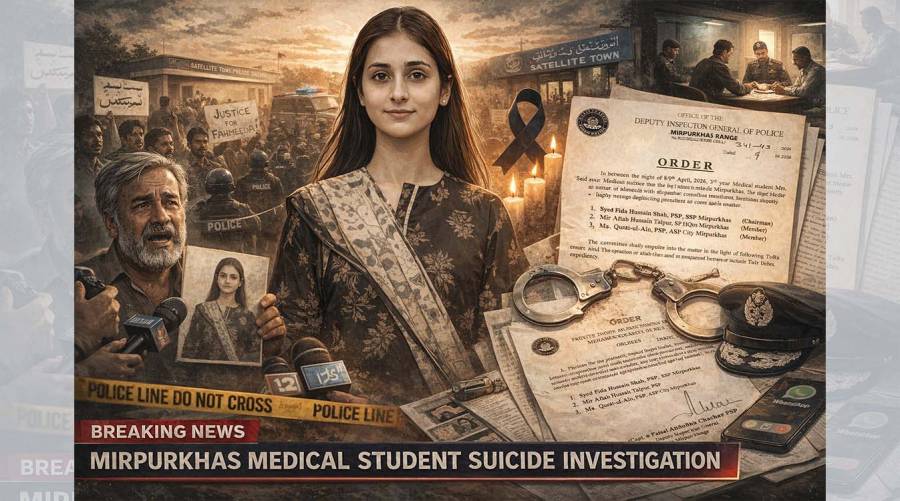
The DIG Mirpurkhas had already formed a three-member senior inquiry committee, constituted through a signed official order issued on 9 April 2026.
The committee comprises:
• Syed Fida Hussain Shah, PSP, SSP Mirpurkhas — Chairman
• Mir Aftab Hussain Talpur, SP Headquarters Mirpurkhas — Member
• Ms Qurat-ul-Ain, PSP, ASP City Mirpurkhas — Member
Its mandate remains highly relevant to the latest allegations. The panel has been directed to establish the factual chain of events, examine any acts of omission or commission, analyze any written or audio material left by the deceased, identify procedural lapses, and recommend legal or departmental action where warranted.
Because the father now alleges prolonged harassment and blackmail, the inquiry’s direction to review acts of omission and commission may become one of the most consequential parts of the final report. It gives investigators room to examine not only alleged direct misconduct, but also whether anyone failed to act on earlier complaints, warning signs, or requests for intervention.
For Pakistan’s medical education sector, this story now carries significance far beyond Mirpurkhas. It raises urgent national questions about female student safety, anti-harassment frameworks, faculty conduct oversight, digital blackmail prevention, mental health escalation pathways, and whether students in professional colleges trust institutional grievance systems enough to seek help before crisis.
The DIG office has already directed the committee to submit its findings within 10 days, ensuring that the next phase of this case will be driven by evidence rather than speculation.
For now, the confirmed picture remains stark: a medical student is dead, the father has made grave allegations, five suspects have been booked, and a senior police committee is under deadline to determine whether this tragedy also reflects systemic institutional failure.
For families sending daughters into professional education, this is no longer just a Mirpurkhas story.
It is a question echoing across every campus in Pakistan:
when a student says something is wrong, who is truly listening before it is too late?
Stay informed, stay aware
CLICK HERE TO JOIN Medical News Pakistan on WhatsApp for real-time updates on medical education, student wellbeing, institutional accountability, and critical health sector developments.

Advertisement
E-PAPER

Trending
Popular
Pakistan’s Dr. Misha Tanveer takes air pollution research to Europe ...
-
Calorie deficit for weight loss: How to ...
06:00 PM, 24 Aug, 2026 -
Vaccine maker warns of wider TBE, ...
05:00 PM, 21 Aug, 2026 -
FDA authorizes first robot to draw ...
06:11 PM, 20 Aug, 2026 -
One blood test for multiple cancers ...
04:52 PM, 11 Aug, 2026
Follow us on Facebook
Follow us on Twitter
Copyright ©2026 Medical News. All Rights Reserved.

