
LUMHS leads Pakistan’s medical universities in THE Impact Rankings 2026
Liaquat University of Medical and Health Sciences, Jamshoro, has secured the 401–600 global band in the Times Higher Education Impact Rankings 2026, placing it ahead of other listed medical and health sciences universities from Pakistan.
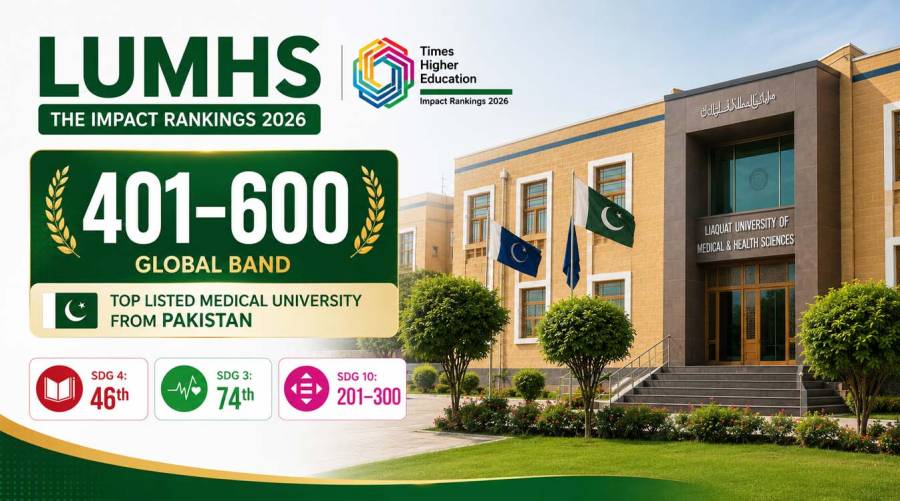
JAMSHORO: Liaquat University of Medical and Health Sciences (LUMHS) has secured a leading position among Pakistan’s medical and health sciences universities in the Times Higher Education (THE) Impact Rankings 2026, entering the 401–600 global band and placing above other Pakistani medical institutions listed in the ranking table.
The achievement places LUMHS at the top among the Pakistani medical and health sciences universities appearing in the THE 2026 ranking list reviewed by Medical News Pakistan, marking a significant international recognition for the Sindh-based public sector medical university.
According to the ranking details, LUMHS has been placed in the 401–600 global band overall in the 2026 rankings. The university also posted notable positions in key Sustainable Development Goal categories, including 46th globally in SDG 4: Quality Education, 74th globally in SDG 3: Good Health and Well-being, and 201–300 in SDG 10: Reduced Inequalities.
LUMHS stands ahead of listed medical universities from Pakistan
The ranking table places LUMHS ahead of several other Pakistani medical and health sciences institutions in the overall THE Impact Rankings 2026.
Among the next listed institutions, Dow University of Health Sciences, Rawalpindi Medical University and Ziauddin University appear in the 601–800 global band. Other medical and health sciences institutions shown in lower bands include Fatima Jinnah Medical University, Shifa Tameer-e-Millat University, and Shaheed Zulfiqar Ali Bhutto Medical University in the 801–1000 band, followed by additional institutions in the 1001–1500 and 1501+ bands.
This makes the LUMHS 401–600 placement particularly important because it positions the university ahead of other Pakistani medical and health sciences universities appearing in the 2026 ranking table.
Strong performance in Quality Education
One of the most striking outcomes for LUMHS is its performance in SDG 4: Quality Education, where the university is listed at 46th globally.
This category assesses institutional contribution to quality education, including educational access, lifelong learning, inclusive teaching practices, and the university’s role in supporting learning beyond its campus.
For a medical and health sciences university, strong performance in quality education is especially relevant because it reflects the academic environment, training systems, educational outreach and institutional contribution to human resource development in healthcare.
The 46th global position also represents a major improvement from the previously reported 201–300 band, indicating stronger international visibility for LUMHS in education-linked impact indicators.
LUMHS ranks 74th globally in Good Health and Well-being
LUMHS has also secured 74th position globally in SDG 3: Good Health and Well-being, one of the most relevant ranking categories for a medical university.
SDG 3 evaluates how universities contribute to health and well-being through medical education, healthcare-related research, community health programmes, public health engagement, clinical training and institutional efforts linked to broader health outcomes.
For LUMHS, this ranking is significant because the university’s core mandate is directly connected with medical education, health sciences training, clinical services, public health and research.
The position also reflects improvement from the earlier 101–200 band, highlighting stronger performance in health-related impact measures.
Reduced Inequalities ranking also improves
In SDG 10: Reduced Inequalities, LUMHS has been placed in the 201–300 global band.
This category looks at institutional efforts linked with inclusion, equity, access, support for underrepresented groups and reduction of disparities within and beyond the university environment.
According to the ranking details shared, LUMHS previously stood in the 601–800 band in this category. Its move into the 201–300 band reflects notable progress in this area.
For a public sector medical university serving students and communities in Sindh and beyond, performance in reduced inequalities is relevant because medical education and healthcare access are closely tied to social mobility, community service and equitable public health outcomes.
What THE Impact Rankings measure
The Times Higher Education Impact Rankings are different from conventional university rankings.
Rather than focusing only on research citations, teaching reputation or institutional prestige, THE Impact Rankings assess universities on their contribution to the United Nations Sustainable Development Goals (SDGs).
These rankings measure how universities contribute to global priorities such as quality education, good health and well-being, reduced inequalities, climate action, gender equality, sustainable communities and partnerships.
For medical universities, these rankings are particularly relevant because healthcare education, community health, public health research, hospital-based training and social impact are central to their institutional purpose.
Why this ranking matters for Pakistan’s medical education sector
The LUMHS ranking is important not only for the university but also for Pakistan’s wider medical education sector.
International ranking visibility can support institutional credibility, research collaboration, academic partnerships, faculty development, student confidence and global engagement.
For students, such rankings provide an additional reference point when assessing medical universities and their international recognition. For faculty and researchers, improved ranking visibility can help strengthen academic networking and collaborative opportunities.
For Pakistan’s health sciences sector, the presence of a public sector medical university in a higher global band demonstrates that local institutions can gain international recognition when their teaching, health impact, research, inclusion and sustainability-related work are documented and evaluated against global indicators.
Not a conventional clinical ranking
It is also important to understand what this achievement represents.
THE Impact Rankings do not rank universities purely on clinical services, hospital performance, medical licensing outcomes or traditional subject-specific academic prestige. Instead, they evaluate institutions through SDG-linked impact indicators.
Therefore, LUMHS’ position in the 401–600 global band should be understood as recognition of its performance in sustainability, social impact, education, health and equity-related indicators, rather than as a direct ranking of hospital services or clinical outcomes.
This distinction makes the achievement more meaningful and more precise.
A major visibility gain for LUMHS
By securing the 401–600 global band overall and strong subject-linked SDG positions, LUMHS has achieved an important international milestone in the 2026 ranking cycle.
Its performance in Quality Education, Good Health and Well-being, and Reduced Inequalities places the university in a stronger global conversation around medical education, public health and institutional social impact.
For Pakistan, the ranking offers a positive signal that medical and health sciences universities can strengthen their international standing by aligning education, research, healthcare delivery, community service and sustainability indicators with global benchmarks.
Stay informed, stay alert!
CLICK HERE TO JOIN Medical News Pakistan on WhatsApp for real-time updates on medical education, healthcare policy, research, rankings and public health developments from Pakistan and around the world.

Advertisement
E-PAPER
Trending
Popular
Pakistan’s Dr. Misha Tanveer takes air pollution research to Europe ...
-
Calorie deficit for weight loss: How to ...
06:00 PM, 24 Aug, 2026 -
Vaccine maker warns of wider TBE, ...
05:00 PM, 21 Aug, 2026 -
FDA authorizes first robot to draw ...
06:11 PM, 20 Aug, 2026 -
One blood test for multiple cancers ...
04:52 PM, 11 Aug, 2026
Follow us on Facebook
Follow us on Twitter
Copyright ©2026 Medical News. All Rights Reserved.