
Sparks, machine noise inside NICH nursery raise safety alarm
Video shows electrically powered repair activity with visible sparks and loud machine noise near newborns as recent audit flags fire-safety gaps at Karachi children’s hospital
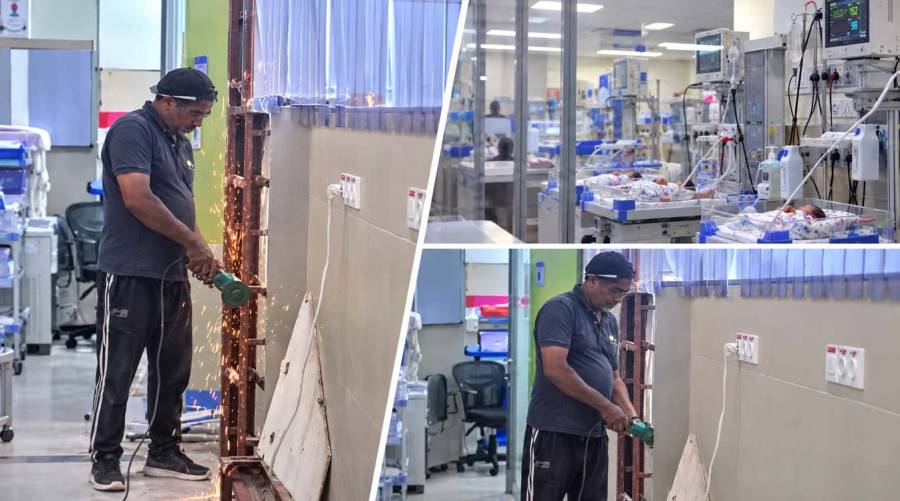
KARACHI: Sparks and loud machine noise inside a nursery caring for newborns at the National Institute of Child Health (NICH), Karachi, have raised fresh questions about patient safety, fire preparedness and the way repair and maintenance work is carried out inside high-risk clinical areas.
A video available to Medical News Pakistan shows a person using an electrically powered machine inside the nursery, with the sound of the equipment clearly audible and sparks visibly coming from the area where the work is being performed. Newborn babies can be seen lying on hospital beds nearby.
The exact type of machine and the precise nature of the repair work have not been officially disclosed.
Media reports, however, said the work involved repairs to an iron structure and was being undertaken to create an emergency exit route and install an iron grille providing access to a semi-critical area.
Sources cited in those reports said between 80 and 120 children were receiving care in the nursery at the time, with most reportedly newborns dependent on oxygen.
What the video shows
The available footage establishes several visible details: a worker is operating an electrically powered machine, the equipment produces significant noise, sparks are visible at the work point and newborns are present in the surrounding clinical area.
Such activities can involve hazards including sparks, hot metal, fumes, electrical shock, harmful radiation, fire and excessive noise. Occupational safety guidance calls for a hazard assessment and task-appropriate protective equipment and controls.
Sparks near oxygen-dependent newborns are concerning
Oxygen itself is not a fuel, but an oxygen-enriched environment can cause combustible materials to ignite more readily and burn more intensely, as recently witnessed in PIMS nursery fire, where 14 newborns lost their lives.
That makes ignition sources an important consideration wherever oxygen-dependent patients are being treated.
The concern is particularly more relevant at NICH because a recent fire-safety audit identified problems involving the proximity of electrical and oxygen infrastructure in the hospital’s Neonatal Intensive Care Unit (NICU). The audit also reportedly identified an oxygen-line leak, exposed electrical wiring and temporary wiring associated with ageing air-conditioning equipment.
The same audit found that NICH’s fire alarm system was non-functional, most smoke detectors were not working, the number of fire extinguishers was inadequate and staff had not received sufficient fire-emergency training or regular drills. Emergency exits were also reportedly blocked by equipment and waste.
The audit, conducted by the Assistant Commissioner of Saddar Sub-Division, classified the hospital’s fourth, fifth and sixth floors as highly vulnerable to fire hazards and highlighted deficiencies in several areas, including the NICU.
Among the findings were:
- electrical and oxygen points installed in close proximity in the NICU;
- leakage in an oxygen line;
- exposed and unsafe electrical wiring;
- non-functional mechanical ventilation in the NICU;
- a non-functional fire alarm system;
- faulty or inactive smoke detectors;
- an inadequate number of fire extinguishers;
- insufficient fire-emergency training;
- lack of regular fire drills; and
- emergency exits reportedly obstructed by equipment and waste.
The audit recommended immediate measures to secure electrical, oxygen and ventilation systems, restore fire alarms and smoke detection, clear emergency exits and conduct regular fire drills.
NICH is one of Pakistan’s biggest public children’s hospitals
The concerns also need to be viewed in the context of the scale of NICH’s operations.
The National Institute of Child Health Karachi is a 550-bed public-sector paediatric hospital providing free lifesaving treatment to more than 1 million patients annually. The institute says patients travel from Balochistan, Punjab and Khyber Pakhtunkhwa, while nearly 1,000 children visit its outpatient department each day.
NICH says it has Pakistan’s largest infant incubator facility and largest paediatric emergency department, and provides 24-hour paediatric surgical emergency services to more than 5 million children within its reach.
The hospital also lists facilities including computerized laboratory services, medical intensive-care services, computerized radiology and other specialised paediatric services.
Its role therefore extends well beyond routine paediatric care. It is a major referral centre for critically ill children, including newborns requiring intensive monitoring and specialised support.
NICH has faced fire incidents before
The hospital's fire-safety concerns are not entirely new.
The September audit referred to a June 30, 2026 fire in the hospital’s ICU and a January 2020 incident in which a newborn died after an incubator caught fire. The audit noted that comprehensive fire-safety arrangements had still not been completed despite those earlier incidents.
That history makes preventive maintenance, emergency access and control of ignition sources particularly important in areas where medically vulnerable children are being treated.
If the latest repair activity was intended to create an additional emergency exit, that objective could potentially improve safety.
The question is whether the work itself was conducted in a manner that maintained the safety of patients during the repair.
PIMS fire adds a painful national context
The NICH footage also comes less than a month after Pakistan experienced one of its most devastating recent hospital fires involving newborns.
On August 26, 2026, a fire broke out in the nursery of the Mother and Child Hospital at the Pakistan Institute of Medical Sciences (PIMS), Islamabad, where 15 newborns were being treated. Fourteen died in the initial incident, while the only surviving newborn later died after 22 days of treatment, taking the death toll to 15.
The subsequent inquiry found that an electrical fault in the supply cable of an air-conditioning unit was the most probable source of ignition and concluded that the tragedy involved systemic and institutional failures in fire safety and emergency preparedness.
The inquiry found that the PIMS nursery had 15 non-self-evacuating newborns despite a stated capacity of 10 beds. It also found that the nursery did not have a functional automatic smoke-detection and fire-alarm system or sprinkler protection, while a documented and rehearsed nursery-specific evacuation system was lacking.
The report further found that dense smoke engulfed the nursery within roughly one to two minutes after the fire became visible, leaving an exceptionally narrow window for rescue.
The PIMS tragedy therefore provides a stark reminder of how quickly an apparently manageable fire-safety problem can become catastrophic when newborns are involved.
The lesson from PIMS is not that every spark will become a disaster.
It is that fire safety in newborn-care areas cannot depend on something going wrong before the system responds.
For NICH and other public hospitals caring for medically vulnerable patients, the critical standard should be prevention: identify foreseeable hazards, isolate patients from maintenance activity, control ignition sources, ensure appropriate PPE and fire protection, keep emergency routes accessible and verify that safety systems actually work.
In a nursery filled with newborns, “nothing happened” is not the same as “nothing was wrong.”
Stay connected with Medical News Pakistan
CLICK HERE TO JOIN the official Medical News Pakistan WhatsApp Channel for verified medical breakthroughs, healthcare innovations, clinical research, public-health developments and important stories shaping healthcare in Pakistan and around the world.

Advertisement
E-PAPER
Trending
Popular
Pakistan’s Dr. Misha Tanveer takes air pollution research to Europe ...
-
Calorie deficit for weight loss: How to ...
06:00 PM, 24 Aug, 2026 -
Vaccine maker warns of wider TBE, ...
05:00 PM, 21 Aug, 2026 -
FDA authorizes first robot to draw ...
06:11 PM, 20 Aug, 2026 -
One blood test for multiple cancers ...
04:52 PM, 11 Aug, 2026
Follow us on Facebook
Follow us on Twitter
Copyright ©2026 Medical News. All Rights Reserved.