
PMDC announces MDCAT 2026 date as Pakistan’s medical education crisis casts shadow over admissions
Pakistan Medical and Dental Council schedules MDCAT 2026 for August 16 amid growing concerns over vacant MBBS and BDS seats, rising tuition costs, falling admissions, changing merit policies and mounting pressure on Pakistan’s medical education system

ISLAMABAD: The Pakistan Medical and Dental Council (PMDC) has officially announced that the Medical and Dental College Admission Test (MDCAT) 2026 will be conducted on Sunday, August 16, 2026, setting the stage for one of Pakistan’s most closely watched academic examinations amid growing concerns surrounding the country’s medical education sector.
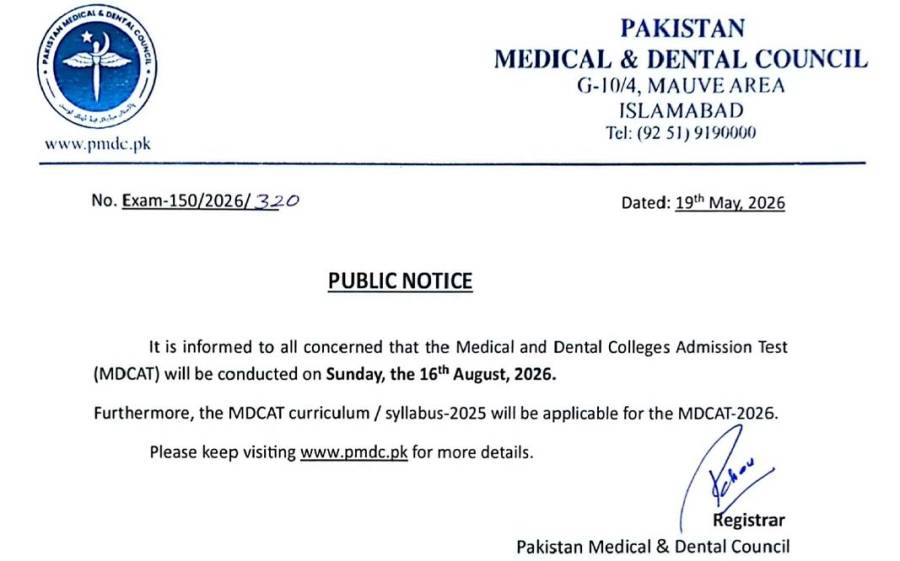
In a public notice issued on May 19, 2026, the PMDC confirmed that the MDCAT syllabus and curriculum notified for 2025 would remain applicable for MDCAT 2026, while advising students to regularly monitor the council’s official website for further updates regarding registration, examination procedures and admission schedules.
The announcement comes at a critical time for Pakistan’s medical education system, which is facing mounting pressure due to an unprecedented rise in vacant MBBS and BDS seats, affordability concerns, declining admissions in private medical colleges and increasing debate over merit criteria and regulatory policies.
Related story: Medical colleges struggle to fill seats as PMDC extends admissions to March 31
What is MDCAT and why does it matter?
The Medical and Dental College Admission Test, commonly known as MDCAT, is Pakistan’s centralized entrance examination for students seeking admission to MBBS and BDS degree programs in public and private medical and dental colleges.
Conducted under the supervision of the Pakistan Medical and Dental Council, the exam serves as a mandatory eligibility requirement for aspiring doctors and dentists across the country.
Each year, hundreds of thousands of students appear for the MDCAT in hopes of securing admission to a limited number of seats, primarily in public sector subsidized medical and dental institutions, making it one of the most competitive academic examinations in Pakistan.
The exam evaluates students in subjects including biology, chemistry, physics, English and logical reasoning, while admission merit is generally calculated using a combination of MDCAT scores, intermediate marks and matriculation results.
Related story: PMDC announces new MDCAT 2025 syllabus and exam structure
Pakistan’s medical colleges facing growing vacant seat crisis
Despite intense competition for public sector medical seats, Pakistan’s private medical colleges have recently faced an unexpected and growing crisis: hundreds of MBBS and BDS seats remaining vacant even after multiple admission rounds.
According to reports and official figures cited in national media, more than 800 MBBS seats remained vacant across Pakistan’s private medical colleges during the 2025-26 admission cycle. Punjab alone reportedly had around 426 vacant MBBS seats, while Sindh recorded approximately 345 unfilled MBBS seats. Additional vacant seats were also reported in Khyber Pakhtunkhwa and Islamabad.
Medical education experts say the trend reflects deeper structural and economic problems affecting Pakistan’s healthcare education landscape.
Why are medical seats going vacant in Pakistan?
Analysts and university administrators point to several interconnected factors contributing to the growing admission crisis in private medical and dental colleges.
One of the biggest reasons cited is the sharp increase in tuition fees at private medical institutions, where annual costs for MBBS programs have risen beyond the financial reach of many middle-class families.
Healthcare education observers say inflation, currency depreciation and increasing operational costs have significantly raised educational expenses in recent years, making private medical education increasingly inaccessible.
Unemployment and low wages are another factor contributing significantly to the admission crisis in medical and dental colleges of Pakistan. According to Gallup Pakistan nearly 4,000 doctors left Pakistan in 2025 — the highest ever on record.
MDCAT 2026 to test PMDC’s regulatory strategy
Education analysts say MDCAT 2026 will not only be an examination for students but also a major test for Pakistan’s medical education regulators.
The central challenge may emerge after the examination process concludes, when colleges begin admission rounds and the country once again faces questions regarding affordability, student eligibility, institutional sustainability and seat occupancy.
Experts believe PMDC may need to balance several competing priorities simultaneously:
- Maintaining academic merit
- Ensuring quality medical education
- Preventing large-scale vacant seats
- Addressing rising educational costs
- Expanding access to medical and dental education
- Protecting healthcare workforce standards
Some analysts also argue that the crisis highlights the need for broader reforms in Pakistan’s medical education system, including scholarship expansion, fee regulation, workforce planning and better alignment between medical seat availability and national healthcare needs.
Students anxiously await further MDCAT details
With the examination date now officially announced, students across Pakistan are expected to intensify preparation efforts for MDCAT 2026 amid continued uncertainty surrounding future admission policies and merit thresholds.
PMDC has advised candidates to continue checking its official platform for registration schedules, examination centers and additional guidelines.
For thousands of aspiring doctors and dentists, MDCAT 2026 may become one of the most consequential admission cycles in recent years — not only because of competition, but because it arrives during a period of major transition and debate within Pakistan’s medical education system.
Stay informed, stay alert
CLICK HERE TO JOIN Medical News Pakistan on WhatsApp for real-time health alerts, expert insights, and breakthrough medical discoveries.

Advertisement
E-PAPER
Trending
Popular
Pakistan’s Dr. Misha Tanveer takes air pollution research to Europe ...
-
Calorie deficit for weight loss: How to ...
06:00 PM, 24 Aug, 2026 -
Vaccine maker warns of wider TBE, ...
05:00 PM, 21 Aug, 2026 -
FDA authorizes first robot to draw ...
06:11 PM, 20 Aug, 2026 -
One blood test for multiple cancers ...
04:52 PM, 11 Aug, 2026
Follow us on Facebook
Follow us on Twitter
Copyright ©2026 Medical News. All Rights Reserved.