From Karachi to global science: Pakistan’s stress scale enters new era of mental health research
Third edition of the Sadaf Stress Scale reflects years of psychophysiology-based research and culturally grounded mental health science
From Karachi to global science: Pakistan’s stress scale enters a new era of mental health research
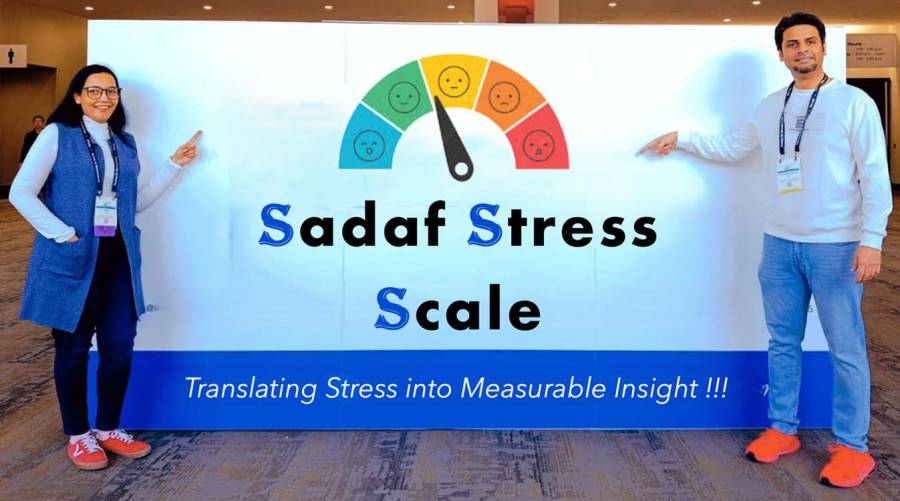
KARACHI: A stress measurement tool developed and refined in Pakistan is gaining renewed scientific relevance with the release of its third edition, marking a milestone in psychophysiology-based mental health research from the Global South.
Researchers Dr. Sadaf Ahmed and Dr. Shamoon Noushad have announced the updated version of the Sadaf Stress Scale (SSS), a multidimensional assessment instrument designed to capture how stress operates across psychological, emotional, and functional domains. The tool integrates principles of neuroscience, physiology, and behavioral science to provide a more complete picture of stress as both a mental and biological process.
The scale was first validated in Pakistan in 2014, when locally developed mental health instruments were scarce and most stress assessments relied on imported tools that often failed to reflect regional sociocultural realities. The SSS was created to fill that gap by combining psychophysiological theory with culturally responsive design.
“Our intention was never to simply produce another questionnaire,” said Dr. Sadaf Ahmed. “We wanted to build a scientifically sound tool that reflects how stress is experienced within our own population, while remaining compatible with international research standards.”
From local need to scientific infrastructure
Early use of the Sadaf Stress Scale helped introduce psychophysiological approaches into mental health research and training environments in Pakistan, where such perspectives had previously been limited. Over time, the instrument has been applied in research studies, clinical contexts, and community-based projects, contributing to work on psychosocial stress, women’s health, education, and public health resilience.
By linking psychological experiences with physiological regulation, the scale promoted an integrated understanding of stress and supported a shift away from purely symptom-based models toward biologically informed mental health research.
What the third version represents
The newly released third edition incorporates refinements aimed at improving clarity, scoring structure, and practical usability across disciplines. These changes reflect evolving expectations in mental health research, including the need for tools suitable for screening, population studies, intervention evaluation, and interdisciplinary work.
“This version reflects years of real-world application,” said Dr. Shamoon Noushad. “The revisions are shaped by how the scale has actually been used in research and clinical settings, allowing it to remain relevant as scientific and practical needs change.”
Rather than remaining static, the Sadaf Stress Scale has followed an iterative development process similar to internationally established psychological and medical assessment instruments.
Global relevance with local foundations
While both researchers are now engaged in broader international collaborations, the scale remains anchored in its original mission: strengthening scientific capacity in low- and middle-income settings through locally developed, methodologically rigorous tools.
“There is increasing recognition that mental health measurement must be both scientifically robust and culturally valid,” Dr. Sadaf said. “When tools from the Global South are built on strong foundations, they can contribute meaningfully to global mental health research.”
As international mental health priorities increasingly emphasize equity, scalability, and context-sensitive assessment, the SSS illustrates how regionally developed instruments can align with global scientific standards without losing cultural grounding.
Implications for research and practice
Accurate stress measurement plays a central role in identifying mental health risks, evaluating interventions, and guiding public policy. The updated Sadaf Stress Scale supports these goals by offering a psychophysiology-informed framework adaptable to both clinical and population-level research.
“Better measurement leads to better care,” Dr. Noushad noted. “Strengthening how stress is assessed, particularly in underrepresented populations, improves the quality of evidence and the effectiveness of interventions.”
The release of the third edition signals not only the evolution of a scientific instrument, but also Pakistan’s expanding role in mental health research rooted in neuroscience and behavioral science.
About the Sadaf Stress Scale
The Sadaf Stress Scale (SSS) is a psychophysiology-informed, multidimensional stress assessment tool developed and validated in Pakistan. Designed for use in research, clinical, educational, and community settings, it captures cognitive, emotional, and functional aspects of stress. Its third edition reflects sustained empirical use and ongoing methodological refinement, reinforcing its position as a scientific contribution from the Global South to contemporary mental health research.
Stay informed, stay healthy!
CLICK HERE TO JOIN Medical News Pakistan on WhatsApp for latest stories, expert tips, health updates, and the medical research straight to your phone.

Advertisement
E-PAPER
Trending
Popular
Pakistan’s Dr. Misha Tanveer takes air pollution research to Europe ...
-
Calorie deficit for weight loss: How to ...
06:00 PM, 24 Aug, 2026 -
Vaccine maker warns of wider TBE, ...
05:00 PM, 21 Aug, 2026 -
FDA authorizes first robot to draw ...
06:11 PM, 20 Aug, 2026 -
One blood test for multiple cancers ...
04:52 PM, 11 Aug, 2026
Follow us on Facebook
Follow us on Twitter
Copyright ©2026 Medical News. All Rights Reserved.