Private medical colleges warn of closure amid PM&DC policy concerns
PAMI urges government to review regulatory approach; PM&DC accused of restrictive policies affecting private institutions’ autonomy and student futures.
KARACHI / ISLAMABAD: The Pakistan Association of Private Medical & Dental Institutions (PAMI) has issued a public appeal warning that continuing governance issues and recent policy decisions by the Pakistan Medical & Dental Council (PM&DC) could threaten the functioning of private medical and dental colleges across the country.
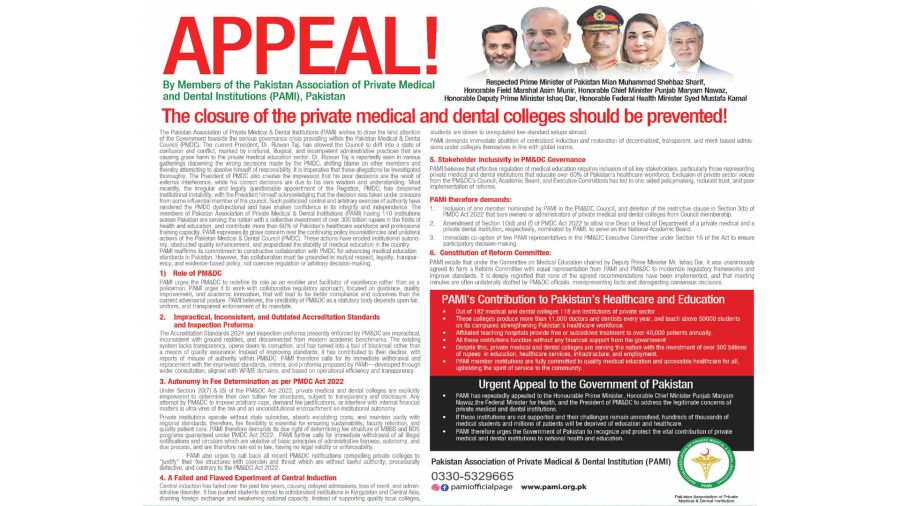
In an advertisement published in national daily newspapers on October 28, 2025, the association claimed that “serious governance lapses” within the PM&DC have created uncertainty in medical education, placing both students and institutions at risk. PAMI alleged that recent administrative actions under the PM&DC Act 2022 were “irrational and inconsistent,” causing confusion and eroding confidence in the regulatory framework.
PAMI’s stance and key demands
According to PAMI, the current PM&DC leadership’s centralized admission system and exclusion of private-sector voices from policy decisions have made it difficult for colleges to operate effectively. The association urged the government to intervene and restore a transparent, decentralized, and merit-based admission process managed by individual colleges in line with “global norms.”
The association also called for:
- Inclusion of PAMI representatives in PM&DC governance bodies, including the Council, Academic Board, and Executive Committee.
- Amendments to sections of the PM&DC Act 2022 that allegedly prevent owners or administrators of private colleges from becoming Council members.
- Immediate creation of a reform committee with equal representation from both PM&DC and PAMI to modernize accreditation and inspection processes.
- PAMI maintains that an inclusive regulatory model is essential for balancing oversight with institutional autonomy and educational quality.
Concerns over accreditation and decision-making
The association criticized what it described as “impractical and outdated” accreditation standards and inspection procedures enforced by PM&DC, arguing that they have caused operational delays and inconsistencies. It further alleged that some official decisions were made “without legality” or contrary to procedural requirements of the PM&DC Act 2022.
PAMI asserted that these developments risk undermining Pakistan’s medical education system and pushing aspiring doctors to seek lower-quality education abroad.
Private sector’s contribution highlighted
PAMI’s appeal also emphasized the private sector’s role in supporting Pakistan’s health and education systems. It claimed that out of 182 medical and dental colleges, 118 are privately run — producing more than 11,000 doctors and dentists annually and teaching over 50,000 students.
According to the association, these institutions provide free or subsidized treatment to over 40,000 patients every year, operate without financial aid from the government, and have contributed over Rs 300 billion in investments in healthcare and education infrastructure.
PAMI argued that any disruption to the private sector’s functioning could deprive thousands of students and patients of access to medical education and healthcare.
Appeal to top leadership
The appeal was addressed to Prime Minister Muhammad Shehbaz Sharif, Chief Minister Punjab Maryam Nawaz, Deputy Prime Minister Ishaq Dar, and Federal Health Minister Syed Mustafa Kamal, urging them to “immediately address” what PAMI described as growing institutional instability.
PAMI said it supports effective regulation and quality assurance but called for a “collaborative, transparent, and evidence-based” approach to policymaking rather than “coercive or arbitrary” enforcement.
Stay informed and protect your health!
CLICK HERE TO JOIN Medical News Pakistan on WhatsApp for expert tips, health updates, and the latest medical research straight to your phone.

Advertisement
E-PAPER
Trending
Popular
Pakistan’s Dr. Misha Tanveer takes air pollution research to Europe ...
-
Calorie deficit for weight loss: How to ...
06:00 PM, 24 Aug, 2026 -
Vaccine maker warns of wider TBE, ...
05:00 PM, 21 Aug, 2026 -
FDA authorizes first robot to draw ...
06:11 PM, 20 Aug, 2026 -
One blood test for multiple cancers ...
04:52 PM, 11 Aug, 2026
Follow us on Facebook
Follow us on Twitter
Copyright ©2026 Medical News. All Rights Reserved.