PIMS fire probe widens as lawmakers question hospital, regulator
NA health committee questions conflicting PIMS accounts and IHRA's regulatory role as PM's inquiry panel examines CCTV, staff statements and fire-safety failures; government announces Rs5m for each bereaved family.
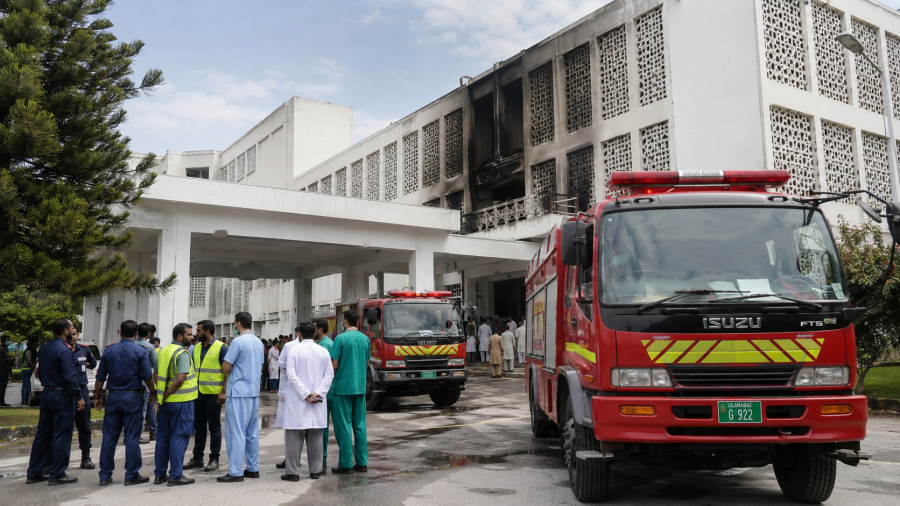
ISLAMABAD: The investigation into the deaths of 14 newborns in the Pakistan Institute of Medical Sciences (PIMS) fire has widened beyond the immediate cause of the blaze, with lawmakers questioning conflicting accounts from hospital staff, raising concerns about the performance of the Islamabad Healthcare Regulatory Authority (IHRA) and demanding answers over how the federal capital's largest public hospital was allowed to operate amid serious safety concerns.
A delegation of the National Assembly Standing Committee on National Health Services, Regulations and Coordination, led by chairman Dr Mahesh Kumar Malani, visited PIMS on Thursday to inspect the site and question hospital officials following the August 26 fire.
The visit produced a significant development: lawmakers said they were not satisfied with some of the answers provided by PIMS staff, while the committee concluded that the precise source of the fire had not yet been established.
Malani said the committee had to determine whether the incident resulted from negligence or a technical or natural cause. He said accounts from doctors and nurses differed, while the possibility of a fault in wiring or oxygen infrastructure was also being examined.
Lawmakers challenge PIMS staff over conflicting accounts
The parliamentary committee's questioning has added a new layer to an already contentious investigation.
According to reporting from the committee's visit, officials provided differing explanations about where the fire originated. One account referred to a spark from a bundle of wires, while other accounts raised the possibility of an oxygen-related fault. Malani said the committee could not yet establish the source of the spark.
The committee also questioned the condition of the nursery itself.
Malani said the nursery was housed in an older building constructed in 1990 and questioned why newborns were being kept there when a newer block was available. He described the old nursery as unsuitable for babies.
The committee has also sought information on the hospital's fire drills, its last fire-safety audit, the functionality of fire alarms and possible human errors.
Committee member Shazia Sobia Aslam Soomro said the conflicting accounts raised the possibility that either no one was properly on duty or that staff who were supposed to be on duty were not at their designated positions.
Another member, Aliya Kamran, said the committee was not satisfied with the account given by the doctor on duty and alleged that staff appeared to have been coached on what to say. Those are allegations by the lawmakers, not established findings, and will need to be tested against CCTV footage, duty rosters and other evidence.
Malani questions need for federal health ministry and structure of public hospitals
The parliamentary committee chairman has also raised a much broader institutional question following the tragedy.
Malani said that, after the 18th Amendment, there was no need for a federal health ministry and argued that the two major public-sector hospitals in Islamabad should instead be placed under independent boards.
He also questioned the need for a federal health minister, framing the PIMS tragedy as evidence of deeper problems in the way major public hospitals are administered.
The proposal, if pursued, would represent a major structural debate extending well beyond the immediate fire investigation.
IHRA also comes under scrutiny
The accountability question is not confined to PIMS.
Malani and members of the parliamentary committee have also raised concerns about the role of the Islamabad Healthcare Regulatory Authority, which is responsible for regulating healthcare establishments in the capital.
The scrutiny comes amid reports that PIMS lacked the required fire-safety NOC and that concerns had previously been raised about fire-safety compliance.
Sources cited by Geo News reported that the Capital Development Authority had written to IHRA twice, asking it not to issue certificates to healthcare facilities without proper fire-safety arrangements. The reports said the authority did not respond to those letters.
That raises a question that investigators will need to answer:
If fire safety was part of the regulatory requirements for healthcare facilities, how did a major public hospital continue operating without the relevant fire-safety clearance?
And if regulatory deficiencies existed, who was responsible for identifying them, enforcing compliance and stopping the renewal of licences where requirements were not met?
These questions are particularly important because the fire-safety concerns reportedly predated Wednesday's tragedy.
The government has promised Rs5m for every bereaved family
While the investigation continues, the federal government has announced financial assistance for the families who lost their newborns.
Parliamentary Affairs Minister Tariq Fazal Chaudhry announced that the government would provide Rs5 million to each family affected by the PIMS fire, covering the families of all 14 newborns who died.
The minister said no compensation could undo the loss or reduce the grief of the parents, but described the payment as an effort to provide some relief to the bereaved families.
He also said that those found guilty of negligence would face exemplary punishment following the inquiry.
Importantly, the compensation announcement does not determine legal responsibility for the deaths. Accountability will depend on the findings of the investigations.
PM's inquiry committee examines CCTV, staff statements
The government's principal investigation is being conducted by a high-level committee constituted on Prime Minister Shehbaz Sharif's orders.
The committee is headed by retired federal secretary Shahid Khan. Its members are Major General (retd) Dr Khurshid Muhammad Uttra, Dr Barrister Nabeel Ahmed Awan and the Deputy Commissioner Islamabad.
Its mandate is considerably broader than simply determining what ignited the fire.
The committee has been tasked with establishing the timeline and immediate cause of the incident, examining the response of hospital staff, the fire brigade and Rescue 1122, reviewing emergency SOPs for transferring newborns, assessing PIMS's fire-safety infrastructure and compliance with regulations, and determining responsibility or negligence, if established.
The committee has already begun gathering evidence.
More than 30 PIMS employees have reportedly had their statements recorded, while investigators have reviewed CCTV footage from cameras installed around the hospital and examined other records and evidence.
Four PIMS officers have also submitted written statements, while the committee has taken possession of relevant nursery CCTV footage and is examining the response timeline.
Interim report due as pressure for answers grows
The original terms of reference required an interim report within 48 hours containing recommendations for immediate action and a comprehensive report within five days.
On Friday, Law Minister Azam Nazeer Tarar told the National Assembly that the interim report was expected to be presented to the prime minister that evening, while the detailed report would follow within seven days. He also said another committee had been formed to propose measures for the revamping and improvement of PIMS.
The government has therefore moved from an immediate crisis response into a wider examination of PIMS's administrative and safety systems.
PIMS itself launches another inquiry
PIMS administration has also constituted its own four-member committee to investigate the fire.
Professor Dr Atif Inam Shami has been appointed chairman, with Deputy Executive Director Dr Aneeza Jaleel, Dr Altaf Hussain and Dr Sajjad Rafiq Abbasi as members. The committee has been directed to examine the cause of the fire, fire-safety measures and the effectiveness and response time of rescue operations.
The existence of multiple investigations means that several versions of events are now likely to be tested against the same evidence.
That evidence — particularly CCTV footage, duty rosters, maintenance records, fire-safety audits, regulatory correspondence and staff statements — could prove crucial.
The bigger question: who was supposed to prevent this?
The emerging picture is no longer simply about a fire that suddenly broke out inside a hospital nursery.
It is about whether the systems designed to prevent such a disaster were functioning before the flames appeared.
The parliamentary committee is questioning whether the nursery was appropriate for newborns, whether fire drills were conducted, whether alarms worked and whether staff were actually at their designated posts. The government inquiry is examining fire-safety compliance and emergency response. Regulators are facing questions over licensing and safety enforcement.
At the same time, the government has already removed Federal Health Secretary Aslam Ghouri following the tragedy, signalling that the issue is being treated as more than a routine hospital incident.
The ultimate test, however, will not be the number of committees formed or statements recorded.
It will be whether investigators can establish what was known before the fire, what should have been done, who was responsible for doing it, what actually happened during the emergency and whether preventable failures contributed to the deaths of the 14 newborns.
For grieving parents, that is the answer that matters most.
And as the parliamentary committee, the government inquiry and PIMS's own investigation proceed, the central question remains:
Was this simply a tragic technical failure — or did institutional failures allow a preventable hospital emergency to become a catastrophe?
Fourteen newborn lives demand a clear answer.
Stay connected with Medical News Pakistan
CLICK HERE TO JOIN the official Medical News Pakistan WhatsApp Channel for verified updates on the PIMS nursery fire, government investigations, hospital safety and accountability, along with the latest breaking health news, medical developments and public-health stories from Pakistan and around the world.

Advertisement
E-PAPER
Trending
Popular
Pakistan’s Dr. Misha Tanveer takes air pollution research to Europe ...
-
Calorie deficit for weight loss: How to ...
06:00 PM, 24 Aug, 2026 -
Vaccine maker warns of wider TBE, ...
05:00 PM, 21 Aug, 2026 -
FDA authorizes first robot to draw ...
06:11 PM, 20 Aug, 2026 -
One blood test for multiple cancers ...
04:52 PM, 11 Aug, 2026
Follow us on Facebook
Follow us on Twitter
Copyright ©2026 Medical News. All Rights Reserved.