
Pakistan in top 5 for TB burden as experts warn of silent spread
DUHS vice chancellor raises alarm on rising tuberculosis cases, calling it a national emergency that still infects thousands—and often goes undetected
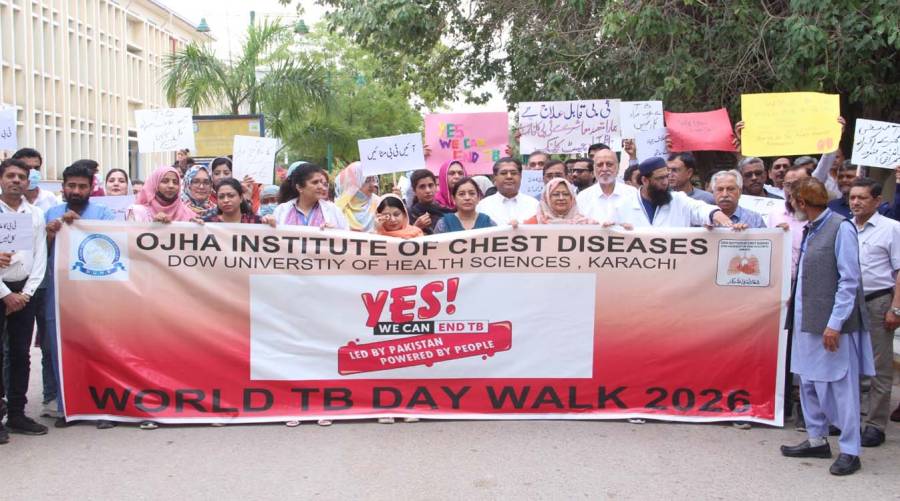
A cough you ignore today could silently infect 10 to 15 more people tomorrow.
That is the scale of the threat Pakistan is facing right now.
In a stark warning that demands immediate attention, Prof. Dr. Nazli Hossain, Vice Chancellor of Dow University of Health Sciences, has revealed that Pakistan ranks among the top five countries globally with the highest tuberculosis (TB) burden—a reality that continues to unfold quietly across communities.
This is not just a statistic.
It is a growing public health emergency.
Speaking at an awareness walk organized by the Ojha Institute of Chest Diseases on World TB Day, Prof. Hossain emphasized that TB remains one of the most persistent and dangerous infectious diseases in both Pakistan and across the globe.
Despite global targets to eliminate TB by 2035, she stressed that achieving this goal will require coordinated and sustained action at every level.
The scale of the crisis is staggering. Pakistan reports nearly 497,700 TB cases every year, yet more than a quarter of patients remain outside the healthcare system—undiagnosed or untreated.
Each year, around 51,000 lives are lost, while children account for a significant proportion of cases.
Globally, the Global TB Report 2025 paints an equally concerning picture, with 10.7 million people falling ill and nearly 22 percent of cases going unreported.
In Pakistan, the incidence stands at 266 cases per 100,000 population, placing the country among the highest-burden nations worldwide.
In Sindh alone, over 154,000 TB cases are estimated, but tens of thousands remain undetected.
This gap between detection and reality highlights a dangerous truth:
many people are living with TB without even knowing it—continuing the chain of transmission.
A critical line of defense
Prof. Hossain highlighted the role of the Ojha Institute, describing it as the largest TB rehabilitation centre in Pakistan, with plans underway for it to become the first WHO Collaborative Centre for TB in South Asia.
The facility offers advanced care, including ICU support and a Biosafety Level-3 laboratory, while providing free diagnosis, treatment, medicines, and nutritional support with the backing of the Sindh government.
What makes TB so dangerous?
TB is not just widespread—it is highly infectious when left untreated.
A single patient can unknowingly infect multiple individuals in a year. The symptoms are often ignored or misunderstood, starting with a persistent cough lasting more than two weeks, followed by fever, night sweats, weight loss, fatigue, and in severe cases, coughing up blood.
This delay in recognition is what allows the disease to spread silently.
The good news is that TB is treatable. Standard treatment lasts around six months, but drug-resistant cases can extend much longer, making early diagnosis absolutely critical.
Experts, including Prof. Jahan Ara Hassan and Dr. Niaz Soomro, stressed that awareness and timely medical attention remain the strongest tools to break the chain of transmission.
A global fight—with local responsibility
The world aims to eliminate TB by 2035, but for Pakistan, reaching that goal will require more than policy—it demands public awareness, stronger healthcare systems, and collective responsibility.
Because TB is not just a disease.
It is a test of how effectively a nation protects its people.
Stay informed, stay protected
CLICK HERE TO JOIN Medical News Pakistan on WhatsApp for real-time health alerts, expert insights, and stories that matter.

Advertisement
E-PAPER
Trending
Popular
Pakistan’s Dr. Misha Tanveer takes air pollution research to Europe ...
-
Calorie deficit for weight loss: How to ...
06:00 PM, 24 Aug, 2026 -
Vaccine maker warns of wider TBE, ...
05:00 PM, 21 Aug, 2026 -
FDA authorizes first robot to draw ...
06:11 PM, 20 Aug, 2026 -
One blood test for multiple cancers ...
04:52 PM, 11 Aug, 2026
Follow us on Facebook
Follow us on Twitter
Copyright ©2026 Medical News. All Rights Reserved.