
426 MBBS seats left vacant after final selection list for Punjab’s Pvt. Medical Colleges
UHS allows colleges to reopen admission portals as concerns grow over high fees, market saturation, and uncertain career prospects for young doctors

Punjab’s private medical colleges left with 426 vacant mbbs seats after final selection list
LAHORE: Punjab’s private sector medical colleges are facing an unusual and worrying situation this year, with hundreds of MBBS seats remaining vacant even after the issuance of the fifth and final selection list.
According to an official notice dated January 24, 2026, issued by the University of Health Sciences (UHS) Lahore, the last date for joining against the final selection list was January 23, 2026. After the closure of the list, a total of 426 seats are still vacant across private sector medical colleges in Punjab.
What makes the situation more striking is that 317 candidates had applied for these vacant seats but later submitted requests for cancellation of admission after initially taking admission, up to January 24, 2026. UHS officials confirmed that 4,350 MBBS seats were available at 33 private medical colleges across Punjab for the 2025–26 session.
Merit trends in the final list
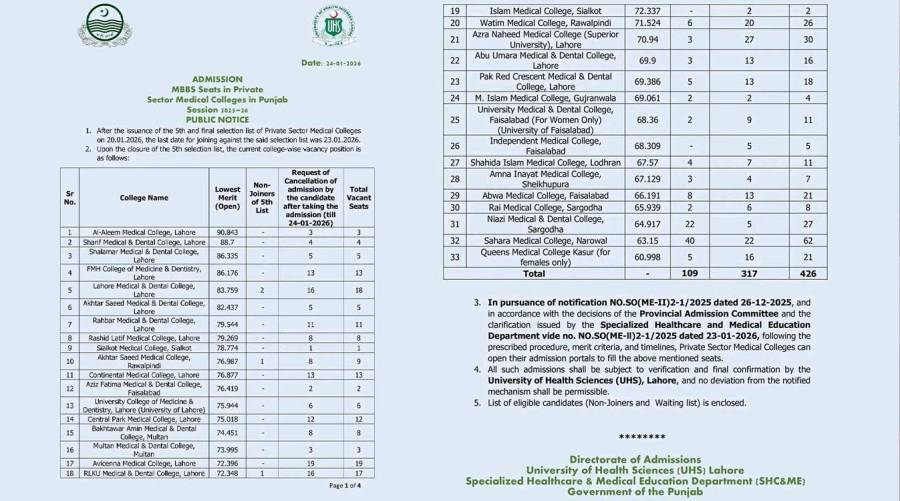
The fifth and final selection list showed wide variations in merit across institutions. Al-Aleem Medical College, Lahore recorded the highest closing merit at 90.843 percent, followed by Sharif Medical and Dental College, Lahore at 88.7 percent, and Shalamar Medical and Dental College, Lahore at 86.335 percent.
At the other end of the spectrum, the lowest recorded merit was at Queens Medical College, Kasur for female candidates only, where it stood at 60.998 percent. These figures reflect a sharp contrast between high-demand institutions and colleges struggling to fill seats despite relatively lower merit thresholds.
Colleges allowed to reopen admission portals
In pursuance of notification No. SO(ME-II)2-1/2025 dated December 26, 2025, and in line with decisions of the Provincial Admission Committee and clarification issued by the Specialized Healthcare and Medical Education Department through notification No. SO(ME-II)2-1/2025 dated January 23, 2025, private sector medical colleges have now been allowed to reopen their admission portals to fill the remaining vacant seats.
All such admissions will be subject to verification and final confirmation by UHS Lahore, and no deviation from the officially notified mechanism will be permitted, the public notice emphasized.
The notification was jointly issued under the authority of the Directorate of Admissions, UHS Lahore, and the Specialized Healthcare and Medical Education Department, Government of Punjab.
Why are so many seats going vacant
While the official notification only reports numbers and procedures, the reasons behind this large number of vacant seats are becoming a subject of intense debate within academic and professional circles.
One widely discussed factor is the perception that Pakistan’s medical sector is becoming saturated. A growing number of young doctors, even after completing MBBS and house jobs, report difficulty in securing stable employment, particularly in the public sector, while others are forced to work on contract or low-paid positions.
People also read: Medical colleges ignore PMDC fee cap for 2025-26 despite notification: Reports
Another major concern is the high cost of medical education in private colleges. Despite the Pakistan Medical & Dental Council (PMDC) setting a cap on annual tuition fees, there are persistent complaints that some institutions charge amounts well above the approved limit through various heads and hidden costs. For middle-class families, the financial burden of paying millions of rupees over five years, with no guarantee of a well-paid job at the end, is increasingly hard to justify.
A warning sign for policymakers
The emerging pattern of vacant seats after multiple selection rounds should be seen as a warning sign for regulators and policymakers.
Experts argue that the Pakistan Medical and Dental Council and the federal and provincial governments must jointly assess whether the current expansion of medical colleges aligns with national health workforce planning. Without parallel growth in hospitals, residency slots, and specialist training programs, policy of producing more medical graduates may need a serious review.
There is also a growing call for stricter enforcement of fee regulations, greater transparency in college finances, and improved career counseling for pre-medical students. Clear data on job prospects, postgraduate training opportunities, and expected earnings could help families make informed decisions rather than relying on outdated perceptions of medicine as a guaranteed route to social and financial security.
The road ahead
For now, private sector medical colleges in Punjab have been given one more opportunity to fill their vacant seats under UHS supervision. Whether these seats will be filled in large numbers, will be known in due time.
Stay informed, stay ahead!
CLICK HERE TO JOIN Medical News Pakistan on WhatsApp for latest stories, expert tips, health updates, and the medical research straight to your phone.

Advertisement
E-PAPER
Trending
Popular
Pakistan’s Dr. Misha Tanveer takes air pollution research to Europe ...
-
Calorie deficit for weight loss: How to ...
06:00 PM, 24 Aug, 2026 -
Vaccine maker warns of wider TBE, ...
05:00 PM, 21 Aug, 2026 -
FDA authorizes first robot to draw ...
06:11 PM, 20 Aug, 2026 -
One blood test for multiple cancers ...
04:52 PM, 11 Aug, 2026
Follow us on Facebook
Follow us on Twitter
Copyright ©2026 Medical News. All Rights Reserved.