
Young innovators from 4 countries take on a crisis the world keeps ignoring
Aga Khan University’s “Bite into Change” brings together young innovators from four countries to tackle one of the world’s most urgent and overlooked crises
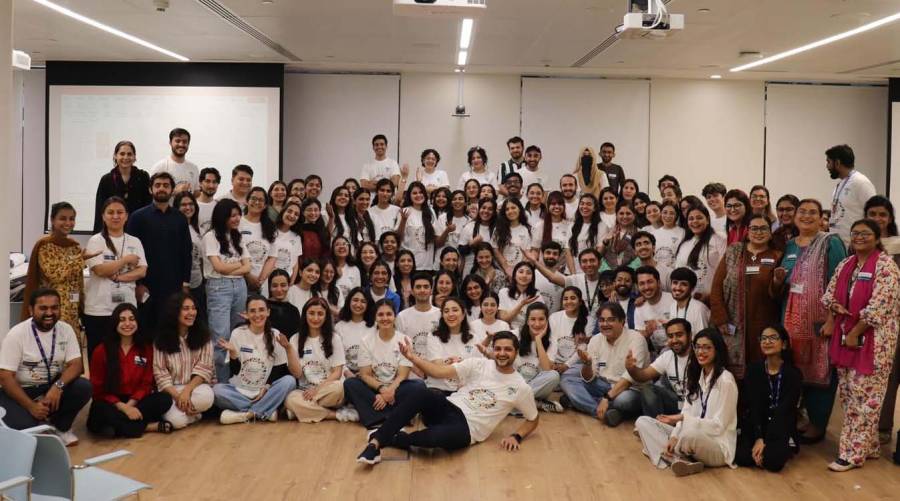
Food is at the center of the climate crisis — and a new generation is stepping up to fix it.
From rising food insecurity to climate-driven disruptions in agriculture, the world is facing a crisis that is no longer distant — it’s here, and it’s accelerating.
Now, a powerful global initiative is turning urgency into action.
The Aga Khan University’s President’s Challenge for Climate Solutions 2025, themed “Bite into Change,” has just completed one of its most critical phases — the Ideation Workshops — and what emerged is far bigger than a student competition.
It’s the early blueprint of solutions that could shape the future of food, health, and climate resilience across developing regions.
A global collaboration with a shared mission
In a rare and inspiring cross-border collaboration, young innovators from Pakistan, Kenya, Uganda, and Tanzania came together with a single goal:
To rethink how the world produces, consumes, and sustains food in the face of climate change.
Guided by expert facilitators, participants moved beyond theory — diving into real-world problem solving, identifying gaps in food systems, and crafting ideas designed for impact in resource-constrained environments.
These were not abstract discussions.
These were ground-level, actionable concepts — shaped by local realities, but with global relevance.
Why this matters more than it seems
Food systems are one of the largest yet most overlooked drivers of climate change.
They impact:
- Public health
- Economic stability
- Environmental sustainability
- And long-term human survival
And yet, solutions often remain fragmented.
What makes this initiative different is its human-centered, innovation-first approach — empowering young minds not just to understand the crisis, but to actively design solutions.
This is where ideas begin to turn into real change.
From ideas to impact: what happens next
With the ideation phase now complete, selected teams will move forward to the next stages of the challenge — where their concepts will be refined, tested, and developed into scalable solutions.
This transition marks a critical shift:
From ideas… to execution.
From discussion… to impact.
And if the momentum continues, some of these ideas could evolve into real-world interventions capable of addressing food insecurity and climate vulnerability across multiple regions.
A signal of something bigger
Beyond the competition itself, this milestone reflects a larger shift:
A growing recognition that young innovators — especially from developing regions — are not just participants in global challenges, but key drivers of solutions.
It also reinforces the role of institutions like Aga Khan University in bridging the gap between academic insight and real-world impact.
Why you should pay attention
Because this is not just about a workshop.
It’s about:
- The future of food systems
- The intersection of climate and health
- And the rise of a generation that refuses to inherit broken systems without trying to fix them
As the next phase of the challenge unfolds, one thing is clear:
The ideas born here won’t stay in the room for long.
Stay informed, stay healthy
CLICK HERE TO JOIN Medical News Pakistan on WhatsApp for the latest health insights, diabetes research updates, and expert tips straight to your phone.

Advertisement
E-PAPER
Trending
Popular
Pakistan’s Dr. Misha Tanveer takes air pollution research to Europe ...
-
Calorie deficit for weight loss: How to ...
06:00 PM, 24 Aug, 2026 -
Vaccine maker warns of wider TBE, ...
05:00 PM, 21 Aug, 2026 -
FDA authorizes first robot to draw ...
06:11 PM, 20 Aug, 2026 -
One blood test for multiple cancers ...
04:52 PM, 11 Aug, 2026
Follow us on Facebook
Follow us on Twitter
Copyright ©2026 Medical News. All Rights Reserved.