Pakistan-China medical partnership gains momentum as KEMU hosts high-level Chinese delegation
Talks at King Edward Medical University focus on transforming Pakistan-China cooperation into practical action through joint research, faculty exchange, technology transfer, genetics, obstetrics and gynaecology, and healthcare innovation under the broader framework of CPEC.
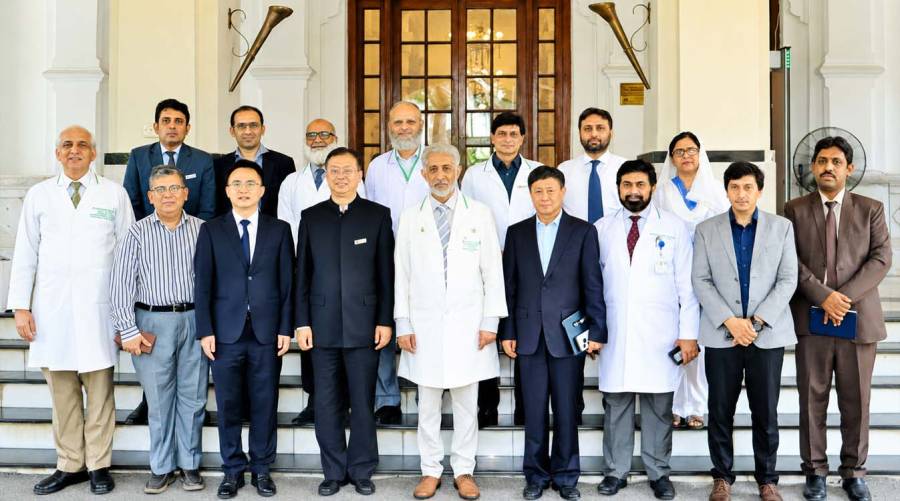
LAHORE: Pakistan and China have taken another step toward expanding strategic cooperation beyond infrastructure and trade, with King Edward Medical University (KEMU) and a high-level Chinese delegation exploring an ambitious roadmap for collaboration in medical education, scientific research, healthcare innovation and technology transfer.
The high-level delegation, led by Mr. Li Jinsong, Founder of Tang Chinese Education, China, visited KEMU to discuss long-term institutional partnerships that could strengthen academic exchange, joint research and human resource development between the two countries.
The discussions reflected a broader shift in Pakistan-China relations, with both sides emphasizing healthcare, medical sciences and research as emerging pillars of bilateral cooperation under the China-Pakistan Economic Corridor (CPEC) and the expanding strategic partnership between Islamabad and Beijing.
Healthcare emerges as a new frontier of Pakistan-China cooperation
The meeting was chaired by Vice Chancellor Prof. Dr. Mahmood Ayyaz, who described the visit as an important opportunity to build sustainable academic and scientific partnerships with one of China's leading educational organizations.
He emphasized that KEMU aims to move beyond ceremonial agreements by promoting practical collaboration in technology transfer, medical research and modern healthcare education.
Referring to the growing importance of innovation-driven healthcare, Prof. Dr. Mahmood Ayyaz proposed launching joint faculty development initiatives, student exchange programmes and collaborative research projects that would allow experts from both countries to share knowledge and expertise.
From Letters of Intent to real action
One of the strongest messages to emerge from the meeting came when the Vice Chancellor stressed that the time had come to transform intentions into implementation.
"The time has come to transform the Letter of Intent into a Letter of Action," he remarked, underscoring the need to convert diplomatic goodwill into measurable academic and scientific outcomes.
He proposed beginning collaboration in Obstetrics & Gynaecology and Genetics, two specialties where joint research and technological cooperation could produce meaningful healthcare benefits.
Prof. Dr. Mahmood Ayyaz also noted that KEMU already has a successful international academic partnership with Astana Medical University, Kazakhstan, demonstrating the university's experience in developing productive global collaborations.
China highlights new opportunities after PM Shehbaz's visit
Speaking on behalf of the Chinese delegation, Mr. Li Jinsong thanked KEMU for its hospitality and pointed to the growing momentum created following Prime Minister Muhammad Shehbaz Sharif's recent visit to China.
He said that 17 major collaborative initiatives, including several in the health sector, had been agreed upon during the visit and that his delegation had come to KEMU to identify opportunities for implementing those commitments.
Mr. Li praised KEMU's strategic vision and confirmed that the delegation had formally submitted written proposals to the university. He also requested a comprehensive institutional profile covering faculty strength, student enrolment, academic programmes and research capacity to facilitate future collaboration.
Wide-ranging delegation reflects institutional commitment
The Chinese delegation included:
• Mr. Li Jinsong, Founder, Tang Chinese Education, China
• Mr. Song Jianying, Chief Executive Officer (CEO), Pakistan
• Mr. Que Haitao, Secretary General, Tang Chinese Education
• Mr. Jin Zhaoyang, Delegate
• Mr. Rayed Khan, Delegate
• Mr. Muhammad Ammar, Coordinator, Tang Chinese Education, Pakistan
Representing KEMU were:
• Vice Chancellor Prof. Dr. Mahmood Ayyaz
• Prof. Dr. Muhammad Moin, Pro Vice Chancellor
• Dr. Umar Waraich, Registrar
• Prof. Syed Asghar Naqi, Professor of Surgery
• Prof. Abrar Ashraf Ali, KEMU Focal Person for China
• Prof. Shoaib Nabi Buzdar, Chief Executive Officer, Mayo Hospital Lahore
• Prof. Imran Hassan Khan, Professor of Medicine
• Prof. Abbas Khokhar, Professor of Oncology
• Prof. Mizna Arif, Department of Pathology
International academic partnerships continue to expand
During the meeting, Prof. Abrar Ashraf Ali, KEMU's Focal Person for China, informed participants that the university is also a signatory partner of BRAMEA Medical University, reflecting its growing engagement in international academic collaboration.
Meanwhile, Mr. Que Haitao, Secretary General of Tang Chinese Education, emphasized the importance of initiating online coordination meetings at the earliest opportunity to accelerate progress on the agreed areas of cooperation.
A broader vision for Pakistan-China healthcare ties
Concluding the discussions, Vice Chancellor Prof. Dr. Mahmood Ayyaz highlighted the decades-long friendship between Pakistan and China, expressing confidence that stronger institutional partnerships would open new opportunities in medical education, scientific research, healthcare innovation, technology transfer and emerging medical technologies.
The Chinese delegation echoed the same vision, describing Pakistan-China friendship as a valuable legacy that should be strengthened through practical cooperation rather than dialogue alone.
With healthcare increasingly emerging as a strategic area of bilateral engagement, the meeting signals that universities may play a central role in translating diplomatic relations into tangible benefits for medical education, research and patient care in both countries.
Stay informed, stay alert!
CLICK HERE TO JOIN Medical News Pakistan on WhatsApp for real-time health alerts, expert insights, and breakthrough medical discoveries.

Advertisement
E-PAPER
Trending
Popular
Pakistan’s Dr. Misha Tanveer takes air pollution research to Europe ...
-
Calorie deficit for weight loss: How to ...
06:00 PM, 24 Aug, 2026 -
Vaccine maker warns of wider TBE, ...
05:00 PM, 21 Aug, 2026 -
FDA authorizes first robot to draw ...
06:11 PM, 20 Aug, 2026 -
One blood test for multiple cancers ...
04:52 PM, 11 Aug, 2026
Follow us on Facebook
Follow us on Twitter
Copyright ©2026 Medical News. All Rights Reserved.