
Scientists just tested world’s first AI-designed vaccine in humans: What happens next?
Scientists at the University of Cambridge say the experimental vaccine uses artificial intelligence to target multiple coronavirus threats at once, but experts caution that larger trials are needed before its real-world potential can be confirmed.
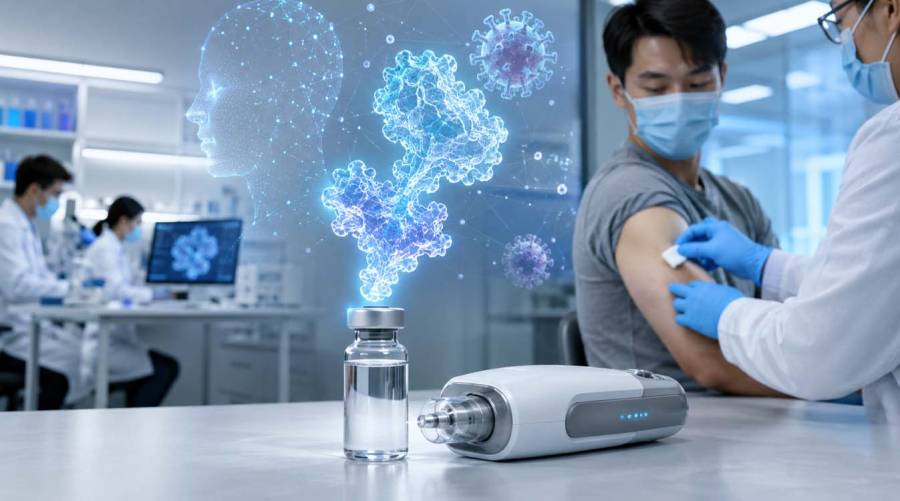
CAMBRIDGE, UK: Researchers at the University of Cambridge have reported encouraging early results from what is being described as the world's first artificial intelligence-designed vaccine to be tested in humans, marking a potentially significant milestone in the future of vaccine development and pandemic preparedness.
The experimental vaccine was designed to provide protection against a broad range of viruses within the sarbecovirus family, including SARS-CoV and SARS-CoV-2, the virus responsible for COVID-19. Unlike traditional vaccines that are developed in response to known circulating strains, the new vaccine uses artificial intelligence and computational biology to identify common viral features that may remain stable even as viruses evolve.
Scientists hope the approach could eventually help create vaccines capable of protecting against future coronavirus threats before they emerge.
A new approach to vaccine design
The vaccine was developed using advanced computational techniques to analyze multiple related coronaviruses and identify conserved regions—viral components that change very little across different members of the coronavirus family.
Researchers then designed a synthetic "super antigen" intended to train the immune system to recognize these shared viral features rather than focusing on a single strain.
This strategy aims to generate broader protection against current and future variants, potentially overcoming one of the biggest challenges in infectious disease control: viral mutation.
The intellectual property associated with the vaccine is owned by DIOSynVax Ltd, the University of Regensburg, and Cambridge Enterprise Ltd.
Needle-free vaccine delivery
Another distinctive feature of the vaccine is its delivery system.
Instead of using a conventional needle and syringe, researchers employed the PharmaJet Tropis system, a needle-free injector that uses fluid pressure to deliver vaccine components through the skin.
Scientists believe such technology could improve patient acceptance, reduce needle anxiety, and simplify vaccine administration in some settings.
What did the first human trial find?
The Phase 1 clinical trial involved 39 participants and was designed primarily to evaluate safety and tolerability rather than effectiveness.
Results published in the Journal of Infection showed that the vaccine generated what researchers described as a modest immune response while demonstrating an acceptable safety profile.
A larger Phase 2 study involving approximately 200 participants is currently underway to further evaluate immune responses and potential effectiveness.
Experts stress that early-stage vaccine trials are designed mainly to identify safety concerns and determine whether larger studies should proceed.
Expert views: promising but still early
Marc Boubnovski, Senior AI Scientist at Novo Nordisk, who was not involved in the research, said the study achieved the primary objectives expected of an early-stage clinical trial.
"The trial achieved what phase 1 trials are mainly meant to test: early safety and tolerability. It also showed some evidence that the design can focus responses on conserved sarbecovirus regions," he explained.
However, Boubnovski cautioned against overstating the findings.
"It did not yet show the strong, broad immune response you would want before calling it a protective universal coronavirus vaccine," he noted.
He also emphasized that the vaccine is not entirely designed by AI alone.
"It's not 'pure AI' in the sense of a system that designs a vaccine end-to-end by itself. It's more like computer-aided engineering for vaccines," he said.
According to Boubnovski, artificial intelligence helps researchers identify promising vaccine candidates more quickly, but laboratory experiments, animal studies, and human clinical trials remain essential for validating safety and effectiveness.
Can AI design vaccines for future viruses?
One of the most attention-grabbing claims surrounding the technology is its potential ability to prepare for viruses that do not yet exist.
Experts, however, say this requires careful interpretation.
Boubnovski explained that AI cannot create guaranteed protection against completely unknown pathogens. Instead, it can identify patterns within families of related viruses and help scientists design vaccines that target common characteristics shared across those groups.
"It is plausible for related future variants or related viruses, not for a completely unrelated new pathogen," he said.
Dr. Monica Gandhi, infectious disease specialist and Professor of Medicine at the University of California, San Francisco, believes the technology represents an important step forward.
She noted that AI was able to rapidly identify common features shared across SARS, SARS-CoV-2, and related sarbecoviruses, allowing researchers to create a vaccine that generated immune responses against multiple members of the virus family.
"This is exactly how this technology could design a vaccine against a virus that doesn't exist yet," Gandhi said.
She explained that these shared viral features are known as conserved elements because they remain relatively unchanged even as new coronavirus variants emerge.
Beyond COVID-19
Researchers are already applying the same AI-driven approach to other infectious diseases with pandemic potential, including influenza and Ebola.
Public health experts have long warned that influenza viruses and coronaviruses remain among the most likely causes of future pandemics due to their ability to spread efficiently between humans.
If successful, universal vaccines capable of targeting entire virus families could transform global pandemic preparedness by reducing the need to redesign vaccines every time a new variant emerges.
Will the public accept AI-designed vaccines?
Public confidence may ultimately determine whether AI-assisted vaccines achieve widespread adoption.
Dr. Gandhi believes acceptance could be improved by the vaccine's needle-free delivery system and by clear communication about how artificial intelligence contributes to vaccine development.
"AI has the power to scan sequences of viruses quickly to determine common elements that allow for cross-protection to different viruses," she said.
She added that transparent public education will be critical to avoiding misinformation and building trust in emerging vaccine technologies.
A milestone, not a breakthrough—yet
While the successful completion of an initial human trial marks an important scientific achievement, experts caution that the technology remains highly experimental.
The coming Phase 2 and Phase 3 studies will determine whether the vaccine can produce strong, durable, and broadly protective immune responses across diverse human populations.
For now, the study offers an early glimpse into how artificial intelligence could reshape the future of vaccine development, helping scientists move from reacting to outbreaks toward anticipating them.
Stay informed, stay alert
CLICK HERE TO JOIN Medical News Pakistan on WhatsApp for real-time health alerts, expert insights, and breakthrough medical discoveries.

Advertisement
E-PAPER
Trending
Popular
Pakistan’s Dr. Misha Tanveer takes air pollution research to Europe ...
-
Calorie deficit for weight loss: How to ...
06:00 PM, 24 Aug, 2026 -
Vaccine maker warns of wider TBE, ...
05:00 PM, 21 Aug, 2026 -
FDA authorizes first robot to draw ...
06:11 PM, 20 Aug, 2026 -
One blood test for multiple cancers ...
04:52 PM, 11 Aug, 2026
Follow us on Facebook
Follow us on Twitter
Copyright ©2026 Medical News. All Rights Reserved.