
World Dengue Day 2026: Half the world now at risk as cases surge globally
WHO and global health experts warn that climate change, urbanization, and international travel are accelerating the spread of dengue, placing billions at risk and making prevention more urgent than ever
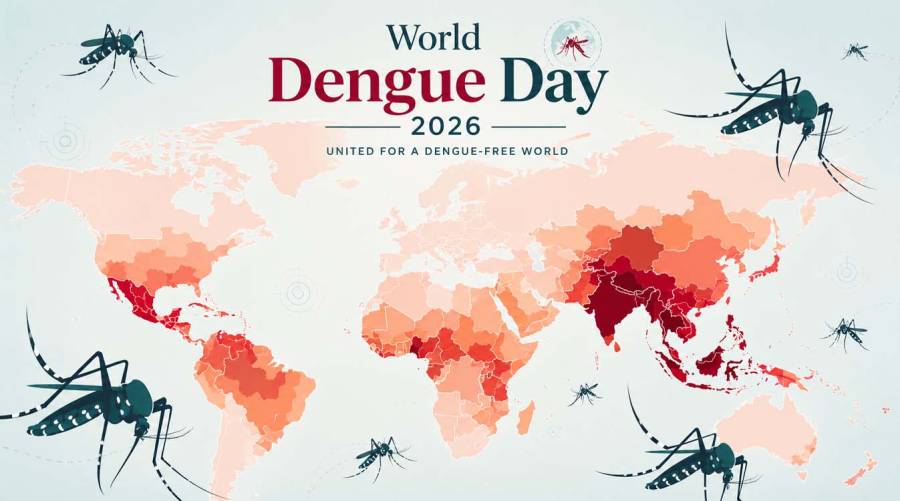
As the world marks World Dengue Day 2026 on June 15 under the theme “One World Against Dengue,” health experts are sounding the alarm over the rapid global expansion of one of the world's fastest-growing infectious diseases.
Once confined to a relatively small number of countries, dengue has transformed into a major international public health threat. Today, more than half of the world's population lives in areas at risk of dengue infection, highlighting the urgent need for stronger prevention, surveillance, and global cooperation.
The observance of World Dengue Day comes as governments, researchers, healthcare professionals, and public health organizations intensify efforts to raise awareness about a disease that continues to spread across new regions due to climate change, urbanization, population growth, and increasing international travel.
A disease spreading at an unprecedented pace
According to the World Health Organization (WHO), dengue is a viral infection caused by the dengue virus (DENV) and transmitted primarily through the bite of infected Aedes mosquitoes, particularly Aedes aegypti.
An estimated 100 million to 400 million dengue infections occur globally each year, although many infections remain undiagnosed or unreported. Some experts estimate the true burden may be even higher.
The disease has expanded dramatically over the past five decades. In the 1970s, only nine countries reported severe dengue outbreaks. Today, dengue is endemic in more than 100 countries and territories across Asia, the Pacific, the Americas, Africa, and parts of the Middle East.
Public health experts estimate that approximately 5.6 billion people, representing more than half of the global population, are now at risk of infection.
Why dengue is spreading worldwide
Health authorities say several interconnected factors are driving dengue's rapid expansion.
Climate change is creating warmer temperatures and changing rainfall patterns that allow mosquito populations to survive and breed in new geographical areas. Urbanization is increasing human exposure to mosquitoes in densely populated environments, while global travel enables infected individuals and mosquitoes to move between regions more easily than ever before.
Experts note that the highly adaptable Aedes mosquito has successfully expanded beyond traditional tropical and subtropical regions and is increasingly being detected in areas previously considered low-risk.
The result has been a dramatic rise in dengue incidence worldwide, with researchers reporting an estimated 30-fold increase in global dengue cases over the past 50 years.
Understanding dengue and its dangers
Many people infected with dengue experience no symptoms or only mild illness. However, when symptoms occur, they typically include:
• High fever
• Severe headache
• Pain behind the eyes
• Muscle and joint pain
• Nausea and vomiting
• Skin rash
• Fatigue
While most patients recover within a few days, some cases progress to severe dengue, a potentially life-threatening condition characterized by plasma leakage, severe bleeding, organ impairment, shock, and other serious complications.
Health experts emphasize that early diagnosis and timely medical care can significantly reduce the risk of severe outcomes and death.
Why the world needs a World Dengue Day
Public health leaders argue that despite its growing impact, dengue has historically received less global attention and investment than many other infectious diseases.
World Dengue Day aims to address this gap by creating a unified platform for awareness, advocacy, research collaboration, and public engagement.
The initiative evolved from ASEAN Dengue Day and has expanded into a global movement that reflects dengue's transformation from a regional challenge into a worldwide health threat.
Advocates say the annual observance helps bring together governments, healthcare providers, researchers, policymakers, industry leaders, and communities to strengthen collective action against dengue.
WHO's response to the growing threat
The World Health Organization continues to support countries through surveillance, outbreak monitoring, laboratory networks, technical guidance, and disease control programs.
WHO works with member states to:
• Monitor dengue outbreaks and epidemiological trends
• Strengthen national surveillance systems
• Improve diagnosis and clinical management
• Enhance mosquito control programs
• Develop evidence-based prevention strategies
• Support implementation of the Global Vector Control Response
• Advance the Global Arbovirus Initiative
• Evaluate emerging tools and technologies for dengue control
The organization also publishes technical guidance and supports research aimed at improving prevention and response efforts worldwide.
Prevention remains the strongest defense
Despite advances in research, there is currently no universally effective cure for dengue. As a result, prevention remains the cornerstone of disease control.
Health authorities recommend several simple but highly effective measures:
• Empty and clean containers that collect standing water
• Cover water storage tanks and buckets
• Dispose of waste properly
• Remove mosquito breeding sites around homes
• Use mosquito repellents
• Wear protective clothing
• Install screens and mosquito nets where appropriate
Public health experts stress that community participation is essential because dengue-carrying mosquitoes often breed in domestic and urban environments.
A global challenge requiring global action
The theme "One World Against Dengue" reflects a growing recognition that dengue is no longer confined by national borders.
As climate change, urban expansion, and international mobility continue to reshape disease transmission patterns, experts warn that dengue's future trajectory will depend largely on how effectively countries work together to strengthen surveillance, improve preparedness, invest in research, and promote community-level prevention.
On World Dengue Day 2026, health leaders are urging governments and individuals alike to recognize dengue as a shared global challenge that requires sustained action long after awareness campaigns end.
Because in an increasingly connected world, preventing dengue is no longer just a local responsibility—it is a global one.
Stay informed, stay alert
CLICK HERE TO JOIN Medical News Pakistan on WhatsApp for real-time health alerts, expert insights, and breakthrough medical discoveries.

Advertisement
E-PAPER
Trending
Popular
Pakistan’s Dr. Misha Tanveer takes air pollution research to Europe ...
-
Calorie deficit for weight loss: How to ...
06:00 PM, 24 Aug, 2026 -
Vaccine maker warns of wider TBE, ...
05:00 PM, 21 Aug, 2026 -
FDA authorizes first robot to draw ...
06:11 PM, 20 Aug, 2026 -
One blood test for multiple cancers ...
04:52 PM, 11 Aug, 2026
Follow us on Facebook
Follow us on Twitter
Copyright ©2026 Medical News. All Rights Reserved.