
CM Sindh breaks ground on NICVD 100-bed cardiac emergency as patient load surges
New facility is expected to expand lifesaving emergency cardiac care at NICVD, where the existing Emergency Department handles up to 1,200 patients daily and the institute treated more than 1.6 million patients in 2025.
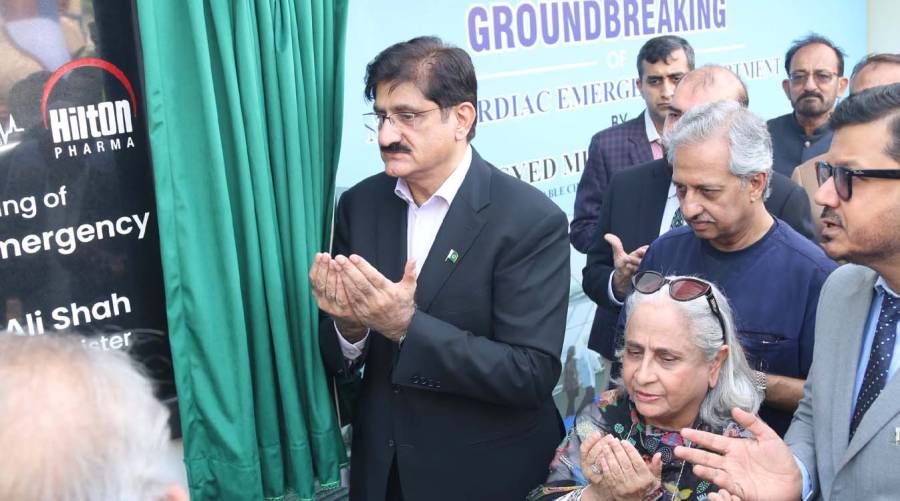
KARACHI: Sindh Chief Minister Syed Murad Ali Shah has performed the groundbreaking of a new 100-bed state-of-the-art Cardiac Emergency Department at the National Institute of Cardiovascular Diseases (NICVD), as the hospital continues to handle an exceptionally high volume of patients from Sindh and across Pakistan.
The new facility is being developed through a partnership between the Government of Sindh, NICVD Patients’ Aid Foundation and Hilton Pharma and is expected to be completed within approximately eight months.
The expansion is aimed at strengthening NICVD's emergency cardiac-care capacity, improving patient flow and providing faster access to assessment, stabilisation and lifesaving intervention for critically ill patients.
NICVD already handles up to 1,200 emergency patients daily
The scale of demand at NICVD helps explain the need for the new facility.
According to figures presented at the groundbreaking ceremony, the institute's existing Emergency Department currently receives between 1,000 and 1,200 patients every day.
These patients include people travelling from different parts of Sindh as well as other provinces, making NICVD a major national destination for emergency and specialised cardiac treatment.
The current figure of up to 1,200 daily emergency patients reflects the existing patient load; it is not a projected figure for the new facility.
The 100-bed emergency department is instead being developed to expand capacity and improve the institution's ability to respond to this already substantial demand.
New facility designed for faster cardiac emergency care
The planned Cardiac Emergency Department will include dedicated areas for different stages of emergency management.
These will include a Triage Unit, Resuscitation Unit, Critical Care Unit and Critical Decision Unit, along with a STAT Laboratory and Fast Track Facility.
The department will also have a pharmacy, waiting area, help desk and other support services designed to streamline patient movement and emergency response.
The project is being developed with a focus on speed, safety and clinical excellence, according to NICVD Executive Director Prof Dr Tahir Saghir.
For patients arriving with acute cardiac conditions, faster assessment and intervention can be critical, making emergency capacity particularly important at an institution dealing with such a large daily patient volume.
NICVD treated more than 1.6 million patients in 2025
The emergency expansion comes as NICVD's overall healthcare activity has grown substantially.
According to statistics presented by Prof Dr Tahir Saghir, NICVD treated more than 1.6 million patients in 2025, compared with approximately 583,000 patients in 2014.
The figures illustrate the scale of growth in patient services at the institution over the past decade.
Thousands of cardiac procedures performed in one year
NICVD's 2025 figures also reveal the scale of specialised cardiovascular treatment being delivered at the institution.
During the year, the institute reported:
- 9,279 primary PCIs
- 18,875 angiographies
- 1,489 cardiac surgeries
- More than 54,000 admissions
- Nearly 297,000 emergency consultations
These figures provide further context for the pressure on the institute's emergency and clinical infrastructure and the importance of expanding its capacity.
A 300-bed paediatric cardiac unit is also under construction
NICVD's expansion is not limited to adult emergency services.
A separate seven-storey, 300-bed paediatric cardiac unit is currently under construction at the institute.
The planned facility will include five operation theatres, four catheterisation laboratories and a hybrid lab, along with CT and MRI facilities and other specialised paediatric cardiac services.
NICVD is also developing a 250-seat conference hall and library to support medical education, research and academic activities.
Together, these projects point to a broader expansion of the institution's clinical, specialised and academic infrastructure.
Existing building being converted into cardiac emergency facility
The new emergency department is being developed by repurposing an existing NICVD building.
The building previously housed outpatient services, which were shifted to the new state-of-the-art OPD Complex inaugurated in December 2025.
The former OPD building is now being converted into the dedicated cardiac emergency facility, allowing NICVD to expand emergency services while making use of existing infrastructure.
Government and private partners support the project
The new 100-bed department is being established with support from the Government of Sindh, NICVD Patients’ Aid Foundation and Hilton Pharma.
Speaking at the ceremony, Chief Minister Murad Ali Shah described the project as more than a construction initiative, saying the facility would strengthen emergency services and help save lives.
Sindh Health Minister Dr Azra Fazal Pechuho said the new facility would enhance NICVD's emergency response capabilities and improve access to timely cardiac care.
She also highlighted the importance of continued investment in healthcare infrastructure, modern technology and specialised treatment facilities.
Eight-month timeline puts focus on delivery
The new Cardiac Emergency Department is expected to be completed in approximately eight months.
Once operational, the 100-bed facility will add dedicated emergency capacity at an institution that is already managing up to 1,200 emergency patients every day and more than 1.6 million patients annually.
Its eventual impact will therefore depend not only on the additional beds but also on how effectively the new triage, critical-care, diagnostic and fast-track services improve the movement of patients through one of Pakistan's busiest cardiac-care centres.
For NICVD, the project represents a significant attempt to match expanding demand with additional emergency infrastructure—at a time when thousands of patients continue to depend on the institution for urgent and specialised heart care.
Stay connected with Medical News Pakistan
CLICK HERE TO JOIN the official Medical News Pakistan WhatsApp Channel for verified global medical breakthroughs, FDA approvals, healthcare innovations, clinical research updates and the latest developments shaping medicine around the world.

Advertisement
E-PAPER
Trending
Popular
Pakistan’s Dr. Misha Tanveer takes air pollution research to Europe ...
-
Calorie deficit for weight loss: How to ...
06:00 PM, 24 Aug, 2026 -
Vaccine maker warns of wider TBE, ...
05:00 PM, 21 Aug, 2026 -
FDA authorizes first robot to draw ...
06:11 PM, 20 Aug, 2026 -
One blood test for multiple cancers ...
04:52 PM, 11 Aug, 2026
Follow us on Facebook
Follow us on Twitter
Copyright ©2026 Medical News. All Rights Reserved.