
PMA warns of healthcare crisis as economic survey exposes Pakistan’s health gaps
Medical association says chronic underfunding, worsening health indicators, and an accelerating brain drain threaten the future of Pakistan’s healthcare system
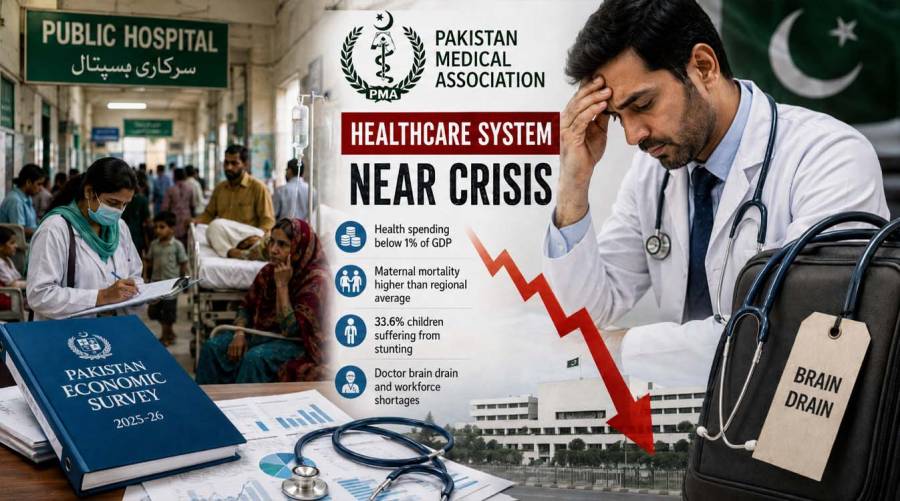
KARACHI: The Pakistan Medical Association (PMA) has expressed serious concern over the healthcare findings presented in the Pakistan Economic Survey 2025-26, warning that the country's health system is facing a deep structural crisis driven by chronic underinvestment, workforce shortages, and deteriorating public health indicators.
In a strongly worded statement, the PMA said the latest survey validates concerns repeatedly raised by the medical community regarding the condition of healthcare infrastructure and service delivery across Pakistan.
Health spending remains below global benchmarks
According to the Economic Survey 2025-26, the Public Sector Development Programme (PSDP) allocation for health stands at Rs19.37 billion, while overall federal and provincial health spending reached Rs942.2 billion during FY2025.
Despite the increase in nominal spending, the PMA noted that Pakistan's public healthcare expenditure remains below 1% of gross domestic product (GDP), significantly lower than international recommendations.
The association argued that sustainable healthcare systems typically require public investment of at least 5% of GDP and warned that inadequate spending continues to force millions of citizens to rely on costly out-of-pocket healthcare expenses.
Pakistan trails South Asian health indicators
The PMA highlighted several indicators from the survey that show Pakistan lagging behind regional averages.
While Pakistan's life expectancy has improved to 67.8 years, the South Asian average stands at 72.6 years.
The association also pointed to Pakistan's maternal mortality ratio of 155 deaths per 100,000 live births, compared with the South Asian average of 120.
Child nutrition indicators remain equally concerning. According to the survey, 33.6% of children under five years of age suffer from chronic stunting, while 16.5% of the population remains undernourished. Both figures exceed regional averages.
The PMA said these statistics reflect longstanding challenges related to poverty, nutrition, maternal health services, and primary healthcare access.
Brain drain masks workforce challenges
Although the survey reports 336,582 registered doctors and 42,118 registered dentists in Pakistan, the PMA cautioned against interpreting these figures as evidence of healthcare workforce strength.
The association stated that rising inflation, limited postgraduate training opportunities, inadequate compensation, and difficult working conditions have accelerated the migration of healthcare professionals abroad.
According to PMA, thousands of doctors, specialists, and nurses continue to seek opportunities overseas, creating staffing shortages in public hospitals and healthcare facilities.
The organization also noted that the number of registered nurses remained stagnant at 138,391, raising concerns about nurse-to-patient ratios and healthcare delivery capacity.
Call for urgent reforms
The PMA warned that without substantial reforms in upcoming federal and provincial budgets, Pakistan's healthcare system could face further deterioration.
To address the crisis, the association called for:
• Increasing public healthcare spending to at least 3% of GDP in the next financial year and 5% by 2030.
• Establishing a uniform and dignified service structure for doctors and healthcare workers nationwide.
• Launching a federally supported emergency programme to address child stunting and malnutrition.
• Expanding investment in Basic Health Units (BHUs) and Rural Health Centres (RHCs) to reduce disparities in healthcare access.
Healthcare must become a national priority
The PMA said the Economic Survey 2025-26 should be treated as a warning rather than a reason for celebration.
The association stressed that healthcare should be recognized as a fundamental public priority and argued that long-term investment in preventive care, workforce development, primary healthcare infrastructure, maternal health services, and nutrition programmes will be essential to improving national health outcomes.
As policymakers prepare future budget decisions, the findings highlighted in the survey are expected to intensify debate over healthcare financing, workforce retention, and the overall resilience of Pakistan's healthcare system.
Stay informed, stay alert
CLICK HERE TO JOIN Medical News Pakistan on WhatsApp for real-time health alerts, expert insights, and breakthrough medical discoveries.

Advertisement
E-PAPER

Trending
Popular
Pakistan’s Dr. Misha Tanveer takes air pollution research to Europe ...
-
Calorie deficit for weight loss: How to ...
06:00 PM, 24 Aug, 2026 -
Vaccine maker warns of wider TBE, ...
05:00 PM, 21 Aug, 2026 -
FDA authorizes first robot to draw ...
06:11 PM, 20 Aug, 2026 -
One blood test for multiple cancers ...
04:52 PM, 11 Aug, 2026
Follow us on Facebook
Follow us on Twitter
Copyright ©2026 Medical News. All Rights Reserved.

