First lady, lawmakers unite for stronger breastfeeding, nutrition laws in Pakistan
Joint declaration signed in Islamabad pledges cross-party action to protect child health, empower mothers, and curb aggressive marketing of breastmilk substitutes.
Islamabad forum marks milestone for maternal, child health
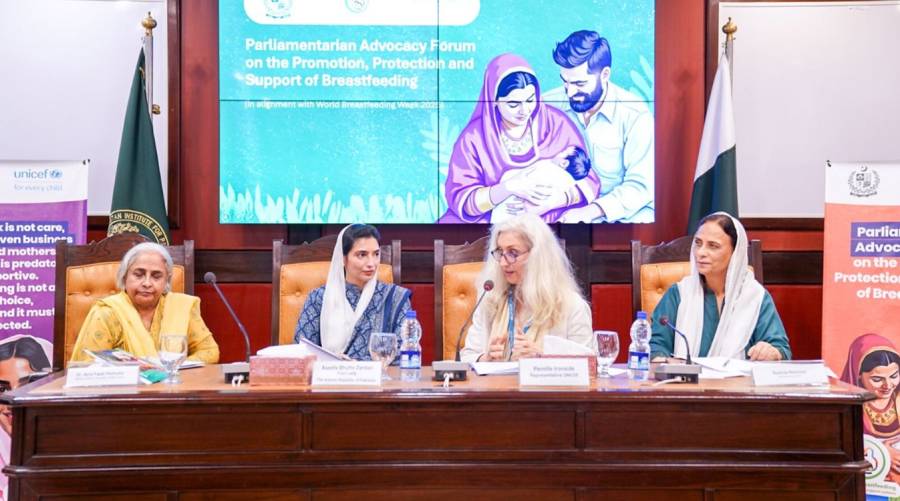
ISLAMABAD: First Lady Aseefa Bhutto Zardari, Sindh Health Minister Dr Azra Fazal Pechuho, and parliamentarians from across political parties have signed a landmark joint declaration on breastfeeding and maternal nutrition in Pakistan, pledging to strengthen laws, protect child health, and empower mothers nationwide.
The agreement was reached during the Parliamentarian Advocacy Forum on the Prevention, Protection and Support of Breastfeeding, jointly organized by UNICEF and the Women Parliamentary Caucus at the Pakistan Institute for Parliamentary Services (PIPS).
The declaration positions breastfeeding as a national investment in health, development, and economic sustainability, calling for strict enforcement of laws regulating the marketing of breastmilk substitutes, integration of breastfeeding promotion into healthcare systems, workplace protections for mothers, and community engagement to shift harmful cultural norms.
Leadership on breastfeeding protection
Delivering the keynote, Dr Azra Fazal Pechuho urged lawmakers not to allow formula milk to be removed from the jurisdiction of the Drug Regulatory Authority of Pakistan (DRAP), insisting it is “a medicine, not food” and must be regulated.
Highlighting the Sindh Protection and Promotion of Breastfeeding and Young Child Nutrition Act, 2023, Dr Pechuho said her government resisted significant pressure from vested interests, with the Sindh High Court dismissing a petition against the law.
She announced:
- Hiring lactation counsellors and therapists in Sindh
- Providing micronutrient supplements to pregnant women
- Continuing campaigns to raise breastfeeding rates
She linked the absence of breastmilk in early childhood nutrition to the rising prevalence of non-communicable diseases such as heart disease and strokes.
Evidence of health and economic impact
Prof Jamal Raza, Executive Director of the Sindh Institute of Child Health and Neonatology, revealed Pakistan loses US$2.8 billion annually due to low breastfeeding rates, with over US$888 million spent on substitutes.
Key data presented:
- Exclusive breastfeeding rate: 48.4% (target: 60% by 2030)
- Raising rates to 70% could save 34,000 child lives annually
- Could prevent 2.8 million diarrhoea cases
- Could save US$55 million in healthcare costs
Prof Raza warned formula feeding exposes infants to infection risks, malnutrition from unsafe water or incorrect preparation, and long-term health risks such as obesity.
Nationwide call for legislative action
UNICEF Representative Pernille Ironside urged replicating Sindh’s law nationwide and prioritizing gender-responsive healthcare systems. UNICEF Nutrition Chief Anteneh Girma Minas called the event a rare policy milestone with the active presence of the First Lady.
Pakistan Paediatric Association President Prof Masood Sadiq recommended:
- Extending maternity leave to six months
- Banning social media advertisements for substitutes
- Adopting a federal breastfeeding law based on Sindh’s model
- Promoting kangaroo care in hospitals
The declaration commits lawmakers to champion breastfeeding-friendly legislation, enforce existing laws, integrate promotion into health systems, and secure funding for maternal and child nutrition programs.
Parliamentarians from PPP, PML-N, PTI, JUI-F, and MQM, predominantly women, pledged cross-party collaboration to protect infants from aggressive marketing of breastmilk substitutes.
Way forward:
Protecting child health starts with empowering mothers. Learn more about evidence-based breastfeeding policies and community programs by visiting UNICEF Pakistan’s resources.
Stay informed. Stay ahead.
CLICK HERE TO FOLLOW Medical News Pakistan WhatsApp Channel for trusted healthcare updates, expert insights, clinical research, policy news, and medical breakthroughs—delivered directly to you.

Advertisement
E-PAPER
Trending
Popular
Pakistan’s Dr. Misha Tanveer takes air pollution research to Europe ...
-
Calorie deficit for weight loss: How to ...
06:00 PM, 24 Aug, 2026 -
Vaccine maker warns of wider TBE, ...
05:00 PM, 21 Aug, 2026 -
FDA authorizes first robot to draw ...
06:11 PM, 20 Aug, 2026 -
One blood test for multiple cancers ...
04:52 PM, 11 Aug, 2026
Follow us on Facebook
Follow us on Twitter
Copyright ©2026 Medical News. All Rights Reserved.