
Trump executive order targets childhood vaccine cuts despite warnings from experts
The order backs a narrower childhood immunisation schedule, calls for vaccines to be given at separate visits and seeks to split the MMR vaccine, drawing strong opposition from paediatricians and other medical experts.
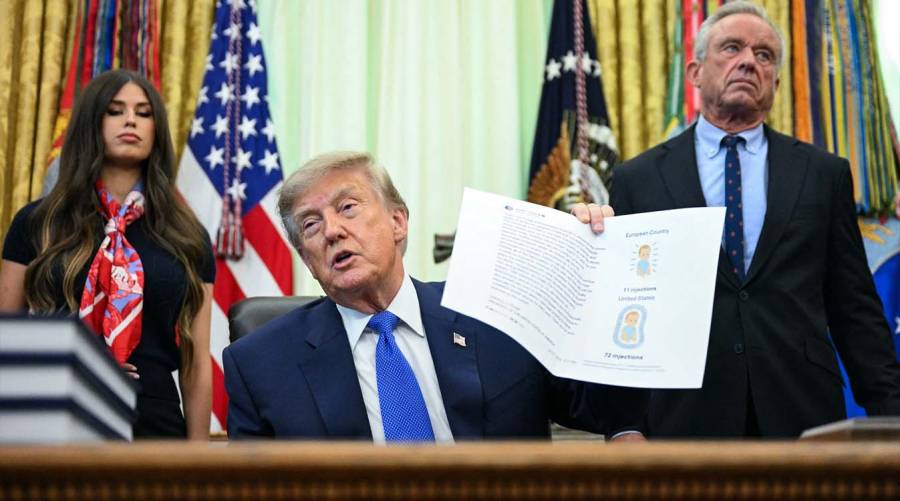
WASHINGTON: US President Donald Trump has signed an executive order targeting major changes to the country's childhood vaccination recommendations, including a narrower list of routinely recommended vaccines and greater spacing between childhood shots, despite warnings from paediatricians and public-health experts.
The order directs the US Department of Health and Human Services (HHS) to advance a revised approach to childhood immunisation and recommends administering vaccines at separate medical visits whenever feasible. It also calls for the measles, mumps and rubella (MMR) vaccine to be divided into three separate vaccines.
The move marks the latest escalation in the Trump administration's effort to reshape the US childhood immunisation framework, but it does not by itself give the federal government direct control over state school-vaccination mandates.
Trump pushes a narrower childhood vaccine schedule
Under the administration's revised approach, 11 vaccines are being identified as the core vaccines recommended for all children, while other vaccines are being moved into categories involving high-risk groups or shared clinical decision-making.
The 11 core diseases include measles, mumps, rubella, polio, pertussis, tetanus, diphtheria, Haemophilus influenzae type B, pneumococcal disease, human papillomavirus and chickenpox.
The administration's approach follows an earlier HHS scientific assessment comparing the US vaccination schedule with those used by other developed countries. The White House has argued that the US previously recommended more childhood vaccines than peer nations and that the revised framework would provide greater flexibility for parents and physicians.
Vaccines that are no longer included in the universal core category can still remain available and may be recommended for children in higher-risk groups or through shared decision-making between clinicians and families.
MMR vaccine could be split into three separate shots
One of the most visible changes sought by the order concerns the MMR vaccine, which currently combines protection against measles, mumps and rubella.
The order recommends separating MMR into three individual vaccines and administering childhood immunisations at separate appointments whenever possible. It also directs HHS to develop a plan for making separate measles, mumps and rubella vaccines available to children in the US.
That proposal could mean additional appointments and longer intervals between vaccinations.
Public-health experts have warned that spreading vaccinations over more visits can create periods during which children remain unprotected against preventable infections, particularly if families are unable to return for subsequent appointments.
There is also a practical issue: separate measles, mumps and rubella vaccines are not currently available as routine individual products for children in the US, meaning implementation would require further action by manufacturers and regulators.
Doctors reject the rationale for changing the schedule
Medical organisations and physicians have strongly criticised the order, arguing that there is no new scientific evidence showing that the established childhood vaccination schedule is unsafe or that fewer routine vaccines would provide better protection.
The American Academy of Pediatrics has maintained its own childhood immunisation recommendations, while experts have warned that conflicting federal and medical guidance could confuse parents and contribute to delayed or incomplete vaccination.
Dr Aaron Milstone of the AAP Committee on Infectious Diseases said the principal effect could be confusion for parents, potentially leading some families to delay vaccination.
The criticism comes from within Trump's own party as well. Republican Sen. Bill Cassidy, a physician and chair of the Senate Health Committee, has publicly opposed the changes, saying vaccines are safe and do not cause autism and arguing that the president lacks the medical expertise to make such changes.
Trump again raises autism-vaccine claims
The executive order has also reignited the long-disputed debate over vaccines and autism.
During the signing ceremony, Trump repeatedly suggested that the number or timing of childhood vaccinations could be related to rising autism diagnoses.
However, decades of scientific research have found no causal link between childhood vaccines and autism. Studies involving the MMR vaccine and broader childhood vaccination have repeatedly failed to establish such an association.
Medical experts have therefore rejected the suggestion that the new policy is supported by evidence showing vaccines cause autism. The issue remains particularly contentious because the administration's health policies have repeatedly brought the vaccine-autism claim back into public debate despite the established scientific evidence.
The order follows an earlier vaccine-policy fight
The latest executive order did not emerge in isolation.
In December 2025, Trump directed HHS and the CDC to examine childhood vaccination practices in peer developed countries and determine whether the US schedule should be changed.
In May 2026, Trump signed another executive order directing the CDC and its Advisory Committee on Immunization Practices (ACIP) to review the HHS assessment and consider changes to the childhood and adolescent vaccine schedule, including greater flexibility over timing and sequencing.
The administration subsequently moved toward a framework in which 11 vaccines would remain routinely recommended for all children, while others would fall into different categories.
But those changes have faced legal challenges.
Federal court has already blocked earlier schedule changes
The current situation is complicated by a federal court ruling that blocked an earlier attempt to revise the CDC's childhood immunisation recommendations.
The CDC's own current vaccine-schedule page says a March 16, 2026, preliminary court order stayed the January 5 decision memo that had revised the childhood immunisation schedule, as well as votes taken by ACIP during its 2025 meetings. As a result, the CDC says the July 2, 2025 schedules remain the current schedules posted for consumers.
Reuters reported that the new executive order nevertheless reaffirms the administration's effort to pursue the narrower schedule while litigation remains ongoing.
This distinction is important: the executive order is a federal policy directive, but it does not automatically erase the existing legal and regulatory processes governing vaccine recommendations and state requirements.
States still control school vaccination mandates
The order also seeks to influence state vaccination policies, but the federal government does not simply have the authority to impose a single nationwide school-vaccine mandate.
Vaccination requirements for school attendance are largely established by individual states. The federal government can influence recommendations, funding and public-health policy, while states retain authority over their own school-entry requirements.
The administration has encouraged states to consider whether their vaccination laws should reflect its preferred approach. That could lead to further policy disputes and potential legal challenges at the state level.
Why experts are concerned about spacing out vaccines
The debate is not simply about the number of vaccines.
The timing of childhood vaccinations is designed to provide protection during periods when children are vulnerable to specific infectious diseases. Delaying a vaccine can extend the period during which a child remains susceptible.
Experts have therefore warned that requiring more appointments could create practical barriers for families, particularly those who face difficulties taking time off work, travelling to medical facilities or returning for multiple appointments.
If a child receives one vaccine but misses a later appointment, the intended protection from the full schedule may not be achieved on time.
The CDC itself continues to describe routine immunisation as an important way of protecting children and communities against vaccine-preventable diseases. Its 2026 RISE initiative specifically focuses on helping children and adults who fell behind on routine vaccinations during the COVID-19 pandemic catch up.
Why the MMR proposal is drawing particular attention
The MMR vaccine protects against three highly contagious diseases: measles, mumps and rubella.
The proposal to split the combined vaccine is significant because it could transform a single vaccination into a series of separate injections and appointments.
Experts have questioned what clinical problem the separation would solve, particularly when the combined vaccine has been extensively studied and used for decades.
At the same time, the US is dealing with renewed concern over measles transmission and gaps in childhood vaccination coverage, making any policy that could delay measles protection particularly sensitive.
The order also calls for more vaccine research
The executive order does not only seek to reduce or reorganise vaccine recommendations.
It also directs HHS to strengthen vaccine research, including further examination of vaccine safety and related scientific questions. The administration has argued that additional research is necessary to improve confidence and transparency around childhood immunisation.
Critics counter that childhood vaccines are already among the most extensively studied medical interventions, with safety monitoring continuing after vaccines enter widespread use.
The central disagreement is therefore not whether vaccine safety should be monitored—medical authorities broadly agree that continued surveillance is necessary—but whether existing evidence justifies the scale and direction of the proposed changes.
Robert F. Kennedy Jr.'s influence remains central
The changes also advance a long-standing priority of Health Secretary Robert F. Kennedy Jr., who has previously promoted claims questioning vaccine safety and has pushed for changes to the US immunisation system.
Reuters reported that the latest order advances a goal Kennedy has pursued within the administration.
The administration has increasingly framed its vaccine policy around parental choice, flexibility, informed consent and what Trump describes as a “gold standard” approach.
Medical organisations, meanwhile, argue that vaccine recommendations should remain grounded primarily in clinical evidence, disease epidemiology and established public-health practice.
What the order means for parents
The executive order does not mean that parents should immediately stop or delay their children's vaccinations.
The legal status of federal vaccine recommendations remains affected by ongoing litigation, while state requirements can differ. Parents should therefore check the current guidance applicable to their location and discuss vaccination decisions with their child's qualified healthcare professional.
For families, the most important issue is whether a child remains appropriately protected against vaccine-preventable diseases—not simply how many injections appear on a government list.
A major test for US vaccine policy
Trump's executive order marks another major step in the administration's attempt to reshape childhood immunisation policy.
It seeks a narrower core vaccine schedule, promotes greater separation between vaccine visits, calls for the MMR vaccine to be split into individual components and directs further vaccine research.
But the administration's proposals face opposition from major medical groups, criticism from some Republican lawmakers and an unresolved legal battle over earlier changes to federal vaccine recommendations.
The larger question now is whether the administration can translate the executive order into a legally sustainable federal vaccination framework—and whether states, physicians and parents will follow it.
For medical experts, the concern is that changing a system built around decades of evidence could create confusion and leave some children unnecessarily vulnerable to preventable disease.
For the administration, the order represents an effort to redefine what it considers a “gold standard” childhood vaccination programme.
The coming legal, regulatory and public-health battles will determine how much of that vision actually changes the way children in the US are vaccinated.
Stay connected with Medical News Pakistan
CLICK HERE TO JOIN the official Medical News Pakistan WhatsApp Channel for verified global medical breakthroughs, FDA approvals, healthcare innovations, clinical research updates and the latest developments shaping medicine around the world.

Advertisement
E-PAPER
Trending
Popular
Pakistan’s Dr. Misha Tanveer takes air pollution research to Europe ...
-
Calorie deficit for weight loss: How to ...
06:00 PM, 24 Aug, 2026 -
Vaccine maker warns of wider TBE, ...
05:00 PM, 21 Aug, 2026 -
FDA authorizes first robot to draw ...
06:11 PM, 20 Aug, 2026 -
One blood test for multiple cancers ...
04:52 PM, 11 Aug, 2026
Follow us on Facebook
Follow us on Twitter
Copyright ©2026 Medical News. All Rights Reserved.