
Sindh hands all remaining primary health facilities to PPHI. What changes now?
The Sindh government has signed an agreement to transfer management of all remaining Primary Health Care facilities to PPHI Sindh, completing a years-long shift toward outsourced management of rural health services that now reaches millions of people across the province.
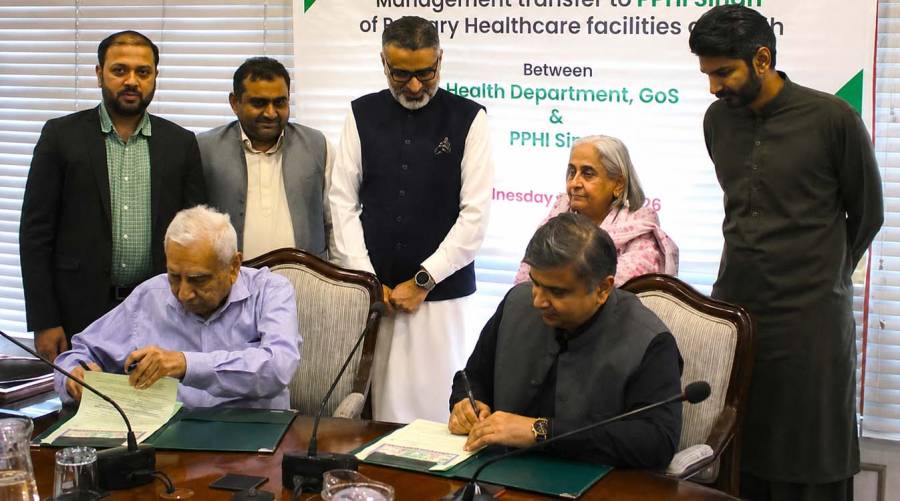
KARACHI: The Health Department of the Government of Sindh has signed an agreement to transfer the management of all remaining Primary Health Care (PHC) facilities in the province to People's Primary Healthcare Initiative (PPHI) Sindh, completing a phased transition that began nearly two decades ago.
The agreement was signed earlier this week by Tahir Hussain Sangi, Secretary Health, Government of Sindh, and Muhammad Suleman Shaikh, Member, Board of Directors, PPHI Sindh, in the presence of Dr Azra Fazal Pechuho, Minister for Health and Population Welfare Department, Government of Sindh, and Javed Ali Jagirani, Chief Executive Officer, PPHI Sindh.
The development effectively places the management of all remaining government primary healthcare facilities under PPHI Sindh, marking one of the most significant reorganisations of public healthcare services in the province in recent years.
What is PPHI Sindh?
PPHI Sindh is not a government department, nor is it a private company in the conventional sense.
It is a not-for-profit organisation registered under Section 42 of the Companies Act, 2017, with a governing board that includes representatives from key provincial departments, including Health, Finance, Planning and Development, and Population Welfare. The organisation operates through formal agreements with the Government of Sindh to manage public primary healthcare facilities on the government's behalf.
Its primary mission is to revitalise healthcare services, particularly in rural and underserved areas, by improving service delivery, staffing, infrastructure and access to essential care.
How did PPHI Sindh begin?
PPHI Sindh traces its origins to 2007, when it first began operations in District Kashmore under a Memorandum of Understanding between the Government of Sindh and the Sindh Rural Support Organisation (SRSO). The initiative was later restructured into an independent nonprofit entity in 2013 and continued its partnership with the provincial government through a fresh agreement.
The original idea behind PPHI emerged from concerns that many government primary healthcare facilities, particularly in remote areas, were struggling with chronic shortages of healthcare workers, limited availability of medicines, inadequate infrastructure and inconsistent service delivery.
The objective was straightforward but ambitious: revive neglected facilities and make quality primary healthcare accessible closer to people's homes.
Why were government facilities handed to PPHI?
Primary healthcare facilities such as Basic Health Units (BHUs), Rural Health Centres (RHCs) and maternal and child health facilities form the foundation of any healthcare system.
They provide first-contact care, immunisation, maternal and child health services, management of common illnesses, disease screening and referrals to higher-level hospitals.
However, many rural facilities historically struggled to deliver services effectively because of administrative and operational challenges.
The contracting model adopted by Sindh sought to provide greater management flexibility and faster decision-making while retaining government ownership of facilities and public financing.
What has PPHI achieved so far?
According to PPHI Sindh, the organisation currently manages more than 1,350 health facilities across 26 districts of Sindh, including dozens of secondary healthcare facilities.
Its reported achievements include:
• More than 44.7 million outpatient visits during 2024
• Over 16.8 million laboratory tests
• More than 359,000 normal deliveries
• More than 1.2 million family planning services
• Hundreds of thousands of antenatal and postnatal care visits annually.
The organisation also reports upgrading more than 300 Basic Health Units into round-the-clock maternity centres, expanding access to maternal and newborn services in remote communities.
Why does this latest agreement matter?
The latest agreement suggests that the Government of Sindh believes the PPHI model has generated sufficiently positive results to justify extending its management approach to all remaining PHC facilities.
For millions of Sindh residents, particularly those living in rural and hard-to-reach areas, primary healthcare facilities often represent the first and sometimes only point of access to healthcare services.
Public health experts widely recognise that strong primary healthcare systems contribute to:
• Earlier diagnosis and treatment
• Improved maternal and child health outcomes
• Better vaccination coverage
• Reduced burden on tertiary hospitals
• More effective prevention and management of infectious and chronic diseases
These benefits are particularly significant in provinces such as Sindh, where geographical barriers and socioeconomic disparities can limit access to specialised healthcare services.
The bigger question
The signing ceremony represents more than an administrative agreement.
It raises a broader question about the future of healthcare governance in Pakistan: can innovative management arrangements help governments deliver better public services while maintaining accountability and equitable access?
As all remaining primary healthcare facilities now transition to PPHI Sindh's management, the next phase will likely be judged not merely by agreements and announcements but by measurable improvements in healthcare access, staffing, service quality and health outcomes experienced by communities across Sindh.
Stay informed, stay alert!
CLICK HERE TO JOIN Medical News Pakistan on WhatsApp for real-time health alerts, expert insights, and breakthrough medical discoveries.

Advertisement
E-PAPER
Trending
Popular
Pakistan’s Dr. Misha Tanveer takes air pollution research to Europe ...
-
Calorie deficit for weight loss: How to ...
06:00 PM, 24 Aug, 2026 -
Vaccine maker warns of wider TBE, ...
05:00 PM, 21 Aug, 2026 -
FDA authorizes first robot to draw ...
06:11 PM, 20 Aug, 2026 -
One blood test for multiple cancers ...
04:52 PM, 11 Aug, 2026
Follow us on Facebook
Follow us on Twitter
Copyright ©2026 Medical News. All Rights Reserved.