
Experts at UHS say future doctors need One Health approach to tackle emerging threats
Medical educators and public health experts at the University of Health Sciences called for integrating the One Health framework into the MBBS Community Medicine curriculum, emphasising interdisciplinary training to prepare future doctors for pandemics, zoonotic diseases and climate-related health challenges.
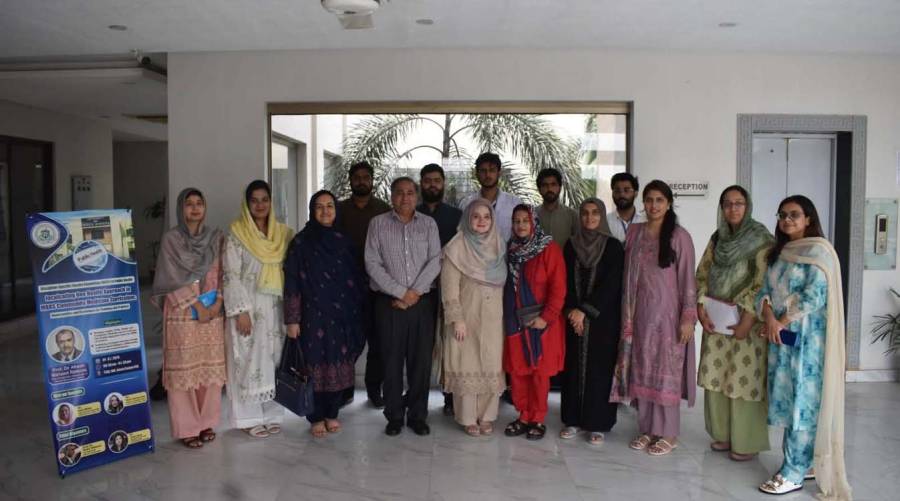
LAHORE: As emerging health threats increasingly blur the boundaries between human, animal and environmental health, medical educators and public health experts at the University of Health Sciences (UHS) have called for incorporating the One Health approach into the MBBS Community Medicine curriculum to better prepare future doctors for the challenges of a rapidly changing world.
The call came during a Discipline-Specific Faculty Council (DSFC) workshop organised by the Department of Public Health at the UHS Jinnah Campus under the theme, "Inculcating One Health Approach in MBBS Community Medicine Curriculum: Opportunities and Challenges for Training and Practice."
The event brought together faculty members from UHS and affiliated medical colleges for in-depth discussions on curriculum reforms aimed at equipping medical graduates with multidisciplinary skills needed to address modern public health challenges.
Opening the session, Prof Dr Shahid Mehmood, Head of the Department of Public Health at the University of Health Sciences, introduced participants to the One Health concept and highlighted its growing importance in responding to increasingly complex health threats that arise from the interconnected relationship between humans, animals and the environment.
He emphasised that emerging challenges such as infectious disease outbreaks, environmental degradation and climate-related health emergencies require healthcare professionals who can think beyond traditional disciplinary boundaries and work collaboratively across sectors.
During the workshop, Dr Sana Iftikhar, Associate Professor of Community Medicine at Allama Iqbal Medical College, traced the global evolution of the One Health framework and explained its relevance to Pakistan through real-world examples, including the COVID-19 pandemic and recurring dengue outbreaks.
She noted that many of today's most pressing public health threats emerge at the interface of human, animal and environmental systems, underscoring the need for future doctors to understand these interconnections and adopt multidisciplinary approaches to prevention and response.
Prof Dr Rozina Shahadat Khan presented practical strategies for embedding One Health principles into undergraduate medical education. She advocated for early student exposure to the concept, interdisciplinary learning experiences and collaborative problem-solving approaches that can help future doctors navigate increasingly interconnected health challenges.
The workshop concluded with an interactive discussion involving senior faculty members from UHS and affiliated medical colleges, both onsite and online. Participants unanimously recommended policy-level integration of the One Health approach into medical education and called for stronger collaboration among medical professionals, veterinarians, entomologists and environmental scientists.
The recommendations reflect a growing recognition within medical education that future healthcare professionals must be equipped to address complex challenges such as pandemics, zoonotic diseases, vector-borne infections, antimicrobial resistance and the health impacts of climate change through coordinated, multidisciplinary action.
As global health emergencies become more interconnected and increasingly difficult to address through isolated approaches, experts at UHS stressed that integrating One Health principles into the MBBS curriculum could play a vital role in preparing future doctors to protect population health in an evolving and uncertain world.
Stay informed, stay alert!
CLICK HERE TO JOIN Medical News Pakistan on WhatsApp for real-time health alerts, expert insights, and breakthrough medical discoveries.

Advertisement
E-PAPER
Trending
Popular
Pakistan’s Dr. Misha Tanveer takes air pollution research to Europe ...
-
Calorie deficit for weight loss: How to ...
06:00 PM, 24 Aug, 2026 -
Vaccine maker warns of wider TBE, ...
05:00 PM, 21 Aug, 2026 -
FDA authorizes first robot to draw ...
06:11 PM, 20 Aug, 2026 -
One blood test for multiple cancers ...
04:52 PM, 11 Aug, 2026
Follow us on Facebook
Follow us on Twitter
Copyright ©2026 Medical News. All Rights Reserved.